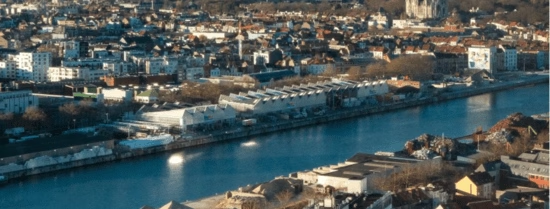
Last week, an inspiring article by Merten Nefs (Erasmus UPT/EUR) and Claire Schelfhout (VUB) was published on Stadszaken.nl about the developments in the Brussels canal zone; an area where urban challenges and innovative solutions come together.
A city under pressure requires smart solutions
The canal zone in Brussels demonstrates how logistics, housing, and circularity can be successfully combined in an environment with extreme pressure on space. With over 1.3 million inhabitants and limited opportunities for expansion, Brussels offers a preview of the challenges many cities in the Netherlands are also facing.
Where logistics in many cities is pushed to the outskirts, Brussels deliberately chooses to integrate it within the urban fabric. This requires smart densification and mixed-use development, or, as it is referred to locally, “weaving.”
Innovative area development along the canal
At the heart of this transformation is the so-called Canal Plan, which focuses on:
- space for 25,000 homes
- approximately 7,000 new jobs
- more than 200 hectares of public space
What stands out is that economic and industrial functions are explicitly preserved. In a city with relatively high unemployment, a productive economy is essential for inclusive urban development.
New typologies: living, working, and logistics
In the Brussels Canal Zone, new urban typologies are emerging where living, working, and logistics coexist. Examples include:
- urban distribution hubs close to residents
- circular construction logistics via waterways
- multifunctional buildings combining business activities and housing
Projects such as Tour & Taxis demonstrate how former logistics areas can be transformed into vibrant urban districts without losing their economic function.
Inspiration for the Netherlands
The insights from Brussels are highly relevant for Dutch cities. Here too, spatial pressure is increasing, creating a need to combine functions more intelligently. While similar developments are taking place, such as in Rotterdam, Utrecht, and Delft, Brussels shows that integrating logistics into the city can go even further.
The full article by Merten Nefs can be read on Stadszaken.nl.

De Kanaalzone in Brussel. Foto: Claire Schelfhout
