
The AI Teaching Fellowship, offered by the Community for Learning & Innovation (CLI), brings together EUR teachers who are forerunners within their faculty in tackling AI, with a special focus on generative AI (GenAI), in education and learning.
Through this Fellowship, the CLI gives EUR teachers the opportunity to further expand their (Gen)AI teaching toolbox. Additionally, they play an important role as ambassadors within their faculty. On this page, you can read more about the AI Teaching Fellows and the projects they are working on.

From policing to engaging AI
Margreet Luth-Morgan, Assistant Professor at ESL
This project, 'From policing to engaging AI', aims to establish AI-integrated learning practices within the law school and beyond. The goal is to shift faculty and student focus from AI-fraud and distrust to productive, ethical AI-supported learning. The central method involves designing and piloting context-specific AI chatbots to function as pre-class preparation assistants and discussion supporters in the new 40-minute bachelor's group sessions. This approach guides students toward using AI for accelerated comprehension and critical legal critique, moving beyond easy answers. Crucially, the project involves co-creation with students (student-centered) and actively sharing experiences with fellow teachers at ESL, EUR and other Law Schools (dissemination).

A practical toolbox for effective and responsible integration of AI into teaching
Aviv Barnoy, Assistant Professor at ESHCC
This AI teaching fellowship focuses on developing a practical toolbox that helps colleagues integrate generative AI into their teaching responsibly and effectively. The project combines personal experimentation with different AI tools, hands-on mentoring for individual teachers, and the creation of clear guidance and workflows. By aligning with university-wide initiatives and drawing on his research on AI epistemology and trust in technology, Barnoy aims to make AI use in teaching both accessible and ethically sound. The fellowship will position ESHCC as a frontrunner in responsible but bold adoption of AI, and provide a model that others across EUR can learn from.
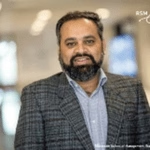
FLOW - Framework for Learning through Open-hearted Writing
Dr. Chintan Kella, Lecturer at RSM
FLOW explores how artificial intelligence can support - rather than replace- human reflection and teaching in higher education. Built around the original AEIO paper-based card game simulation and digitised by Chintan using "vibe-coding", the project is embedded in a Bachelor's-level course where students engage in handwritten reflective writing to immerse them in the lived dynamics of inequality, inclusion, and collaboration. Following the simulation, students engage in handwritten reflective writing, preserving reflection as a deeply personal, embodied, and meaning-making practice.
FLOW delivers three core outcomes:
- A pedagogical framework for integrating open-hearted, handwritten reflection into experiential learning designs while maintaining reflection as a distinctly human cognitive and emotional process.
- An AI-enabled analytic dashboard that aggregates anonymised reflective writing to surface patterns in student wellbeing, engagement, and teamwork dynamics for instructors and course teams.
- An ethical model of human–AI complementarity in education, demonstrating how large language models can enhance pedagogical sense-making without intervening in individual learning trajectories.
FLOW advances a transferable and ethically grounded framework that can be adopted across university curricula, aligning experiential learning, personalised reflection, and responsible AI use.
AI-simulated Patients in Medical Education
Emil Verhoofstad, Lecturer at EMC
The promise of GenAI is that domain experts can drive change and enrich learning materials without relying completely on technical specialists. However, it remains challenging to implement AI in a practical, ethical and safe way. My project will help our department bridge this last mile. I will explore a broad range of GenAI applications with a primary focus on AI-simulated patients for clinical reasoning and communication skills training. The aim is to embed these as pilots in existing courses and evaluate these with students and teachers. To scale beyond individual pilots, I will develop a modular foundation; reusable building blocks that allow any medical instructor to create their own AI simulations by simply providing their own clinical scenario, without needing to build from scratch. In parallel, I will upskill instructors and cooperate with a cross-faculty network of experts. The final goal is to keep pace with GenAI so we can prepare for the major shifts it will bring, especially for the next generation of doctors.

Critical AI Literacy: Engaging Infrastructures of AI
Jop Dispa, Lecturer at EUC
Higher education debates banning or embracing AI, but both ignore a key question: what is AI made of? How do these systems extract resources, exploit labour, and serve specific interests?
This fellowship develops critical AI literacy, teaching students to trace AI through material foundations (minerals, energy), labour chains (mining, assembly), and political entanglements (whose interests are encoded). Students examine AI as assemblages embedded in power relations rather than neutral innovation. Using an infrastructural approach and "Anatomy of AI" methodology, students map AI systems, learning to critically interrogate these technological infrastructures and develop a ‘critical AI literacy’
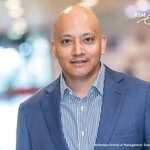
GenAI Applications in the Context of Entrepreneurial Thinking
Maurice de Rochemont, Lecturer at RSM and Academic Director at Erasmus Centre for Data Analytics
This project aims to support educators across Erasmus University through the responsible use of Gen-AI. By sharing knowledge on how Gen-AI can be used in the context of entrepreneurial thinking, educators learn how ideas can be translated into interactive outputs, such as no-code applications. In parallel, the project supports teachers in exploring and applying Gen-AI in their own courses through workshops, examples, and practical guidance.
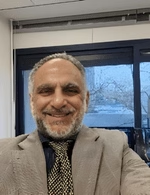
Re-designing Economics Education for an AI-transformed World
Sacha Kapoor, Associate Professor at ESE
This project prepares economics students for an AI-transformed world while helping faculty navigate technological change. Three goals: First, developing a custom AI tool for econometrics that teaches critical evaluation of AI outputs. Second, integrating AI literacy into bachelor's econometrics curriculum through systematic review. Third, contributing to community initiatives and resources if aligned with fellow interests. The philosophy: as AI makes intelligence abundant, economics education must focus on distinctly human capabilities—conceptualization, contextual judgment, communication—while preparing students to understand AI's economic implications. Economics is uniquely positioned to study AI's societal impact while transforming teaching methods.
Exploring the Potential of an SSH-focused LLM for Education
Sonia de Jager, postdoc at ESPhil
This fellowship explores how an SSH-focused LLM can help rethink critical teaching and learning. The LLM project is currently underway and we are in the process of seeking feedback and advice from a context such as the one CLI offers. By running AI sessions at the philosophy faculty; by inviting fellows to work on real classroom challenges; by testing the LLM’s abilities; as well as by exploring and designing novel approaches to LLM-interface (beyond the chatbot format): this fellowship will dedicate research time to a crucial point of pedagogical inflection in our path: academic research in times of GenAI. Working together with different EUR GenAI networks, we will be able to triangulate different needs and desires, which will directly inform the development of the project.