
Is this the programme you're looking for?
Do you want to critically examine how global politics, economics, and culture shape our world today? And do you want to learn to understand current global events based on long-term historical processes, centuries of globalization, cultural exchange, and international connections, that continue to influence us today? In short, do you want to delve into issues in the field of international relations? Then the specialisation Global History and International Relations is the master’s programme for you.
Practical information
- Type
- Master
- Degree
- MA
- Mode of study
- Full-time | Part-time
- Instruction language
- English
- Duration
- 1 year
- Study points (EC)
- 60
- Location
- Campus Woudestein
- Start date
- September
- Application Deadline (EEA)
- 15 May
The study programme in a nutshell
At the core of Global History and International Relations lies a fundamental question: what unites and what divides people, societies, and states across time and space? You will examine how individuals, nation-states, and empires have engaged on the international arena, exploring both the ties of trade, diplomacy, and cultural exchange that bound the world together, as well as the conflicts, inequalities, and ruptures that tore it apart. Learning here goes beyond the classroom: you’ll work in archives and museums with primary sources, such as journals, pamphlets, diplomatic records, to build and analyze original, evidence-based arguments about why people, regions, nations, and empires interact, align, and clash as they do.
''This program has a very different approach to history than traditional history programmes often have.''

What you will learn
- Study world politics from a transdisciplinary and global perspective (one that avoids all centrisms: Western centrism, Sino-centrism, anthropocentrism, etc.);
- Examine how (world) history itself is used, abused, mobilized, and sometimes weaponized by global actors in contemporary world affairs;
Study international relations in a historical context using approaches from the social sciences, international political economy, and cultural analysis; - Examine the rise of the Global South after centuries of Western dominance;
- Study the role of political economy, security alliances, climate, infrastructure, technology, digital phenomena, trade, and cultural heritage in today’s world;
- Gain digital skills to conduct research in the fields of history and international relations.
Is this the right programme for you?
Would you like to explore current issues relating to historical processes of globalisation, international interactions and social, cultural and economic encounters? Would you like to learn more about the world, in all its complexity, in a different way to that offered by traditional history degree programmes? If so, choose the Global History and International Relations Master’s specialisation.
Want to know more? Meet us here
Career opportunities after graduation
The Global History and International Relations programme at Erasmus University Rotterdam will give your career as a historian, policymaker, policy analyst or academic a flying start. However, you could also find work as a manager or researcher at cultural institutions, government bodies (local or national), consultancy firms, archives or in the media.
What do our students think?


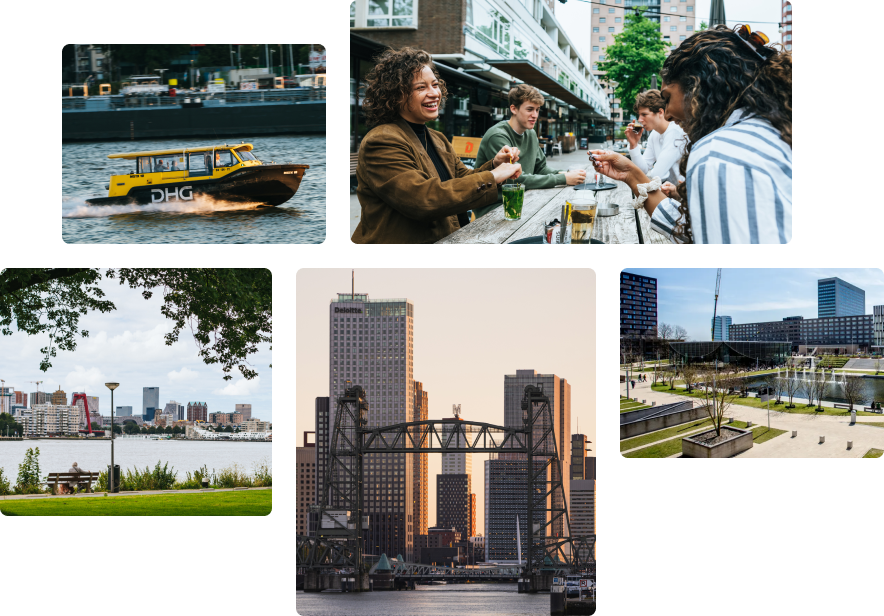
Your student life starts in the vibrant city of Rotterdam
This vibrant city offers a variety in art, nightlife, culture and sports. Everything you wish for to enjoy your student life to the fullest.
Not sure yet about your choice? Request a brochure!
Choosing a study is quite a challenge! Still in doubt about this study and want to have a good overview? Receive a clear digital brochure for this study.