TeachEUR
Exploration
Support
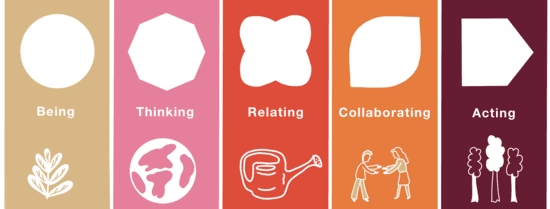
In a world facing complex societal challenges, strengthening students’ capacity to make a meaningful impact is becoming an important goal of higher education. This calls for greater attention to personal development, as contributing to society requires more than disciplinary knowledge alone. The Inner Development Guide (IDG) offers a practical framework to support students’ personal growth and prepare them for engaged, impact-driven professional lives. It brings together 25 skills across five dimensions and provides a shared language for personal development.
Inner Development Guide for personal development
The Inner Development Guide (IDG) offers a clear, structured way to speak about and work with students’ personal development. The framework brings together 25 skills, organized into five dimensions: Being, Thinking, Relating, Collaborating and Acting. These five dimensions represent different aspects of personal development, and each provides a practical entry point for educational activities. Explore the pages below to discover teaching activities that translate the framework into practice and offer tools and inspiration to help strengthen students’ inner capacities and their ability to contribute to positive societal impact.


Q&A about this toolbox
The Inner Development Guide offers a practical framework for supporting students’ personal growth and preparing them for engaged, impact-driven professional lives. The IDG framework is designed to cultivate the personal skills and qualities that individuals and communities need to address complex global challenges. It organizes 25 skills into five dimensions: Being, Thinking, Relating, Collaborating, and Acting, providing a shared language for speaking about personal development.
For teachers who primarily want to strengthen personal development, the IDG offers a structured, internationally recognized lens through which to design learning activities. Because the framework is open-source and used worldwide, teachers can easily draw on a growing ecosystem of educational tools, activities, and shared practices.
For teachers who are driven by engaged learning and societal impact, the IDG is even more relevant. It was created by over 1000 experts and practitioners working on sustainability, leadership. The framework directly complements the Sustainable Development Goals by focusing on the inner transformation required to achieve outer change. It helps students build the emotional, relational, and cognitive capacities needed to work on real-world challenges exactly the capacities that enable graduates to become effective changemakers. It emerged from a multi-year learning journey involving diverse stakeholders, including universities, business schools, and sustainability experts, and was officially launched in 2021. In 2025 the framework went through an evaluation process. As a result, some skills were replaced. We use the older version.
The Erasmian Values describe the kind of graduates we hope our students will become: open-minded, socially engaged, entrepreneurial, connected to others, and aware of their place in the world. To live these values, students need more than disciplinary knowledge. They need personal capacities that help them navigate complexity, relate to diverse people and act with purpose.
The Inner Development Goals provide exactly these underlying capacities. The five dimensions mirror what the Erasmian Values ask of students. The skills in Thinking support an open and critical mindset and help students understand global challenges. Relating and Collaborating nurture empathy, inclusivity and trust—essential for connecting through diversity and engaging with society. Acting encourages creativity, courage and perseverance, which lie at the heart of entrepreneurship and meaningful change. And Being helps students develop self-awareness and an inner compass, grounding their choices in their own values.
Seen this way, the IDG offers a practical route to bringing the Erasmian Values to life in the classroom. Instead of treating the values as abstract ideals, teachers can use the IDG elements to create learning experiences that help students practise them, reflect on them and gradually make them their own.
Personal development grows when teachers create the right conditions. These 14 practices help you get the most impact out of every activity, simply by using your existing teaching strengths.
1. Begin with a “why.”
A short purpose statement opens the door to meaningful engagement.
2. Spark curiosity with an essential question.
Hook students by letting them explore a question that matters to them.
3. Build psychological safety from the start.
No grading, no pressure. Just clarity, respect, and room to explore.
4. Share a brief personal example.
A short example from your own experience can help set the tone
5. Protect student agency.
Offer choices in how they reflect, respond, or participate.
6. Strengthen their sense of competence.
Use small steps, model examples, and clear framing.
7. Foster belonging.
Small moments like warm tone, knowing names and noticing effort, build trust fast.
8. Celebrate mistakes as part of learning.
Students relax when they see that imperfection is not a failure.
9. Coach through questions, not solutions.
Your curiosity teaches them to be curious too.
10. Make the academic-personal link explicit.
Show how personal development strengthens their disciplinary and professional growth.
11. Use clear, constructive feedback.
Help students see their progress and their next step.
12. Guide reflection with simple structures.
“What? - So What? - What Now?” turns insight into action.
13. Model the skills you teach.
Presence. Listening. Courage. Curiosity. It starts with you.
14. Cultivate strong group norms.
Students collaborate better when expectations are co-created.
- This work is inspired by the Inner Development Goals. Learn more at https://innerdevelopmentgoals.org
- The Transition makers toolbox provides more activities connected to the IDG's to explore.
