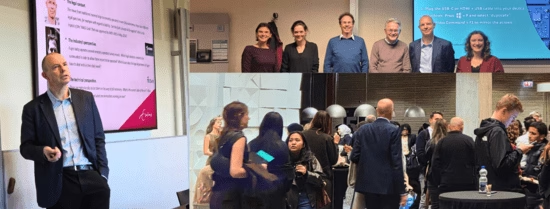
The shipping industry is facing numerous challenges. Decarbonisation requirements, geopolitical instability and a shrinking workforce are just a few examples. The law is an indispensable tool to regulate commercial solutions, but it represents only one of several relevant perspectives. Today's challenges call for a broader, multidimensional approach. Alongside legal considerations, technical, practical, political and economic aspects must also be taken into account. Against this background, Erasmus School of Law's Law and Markets Department has launched a series of masterclasses exploring emerging developments in the maritime industry from a broader perspective.

Written by: Frank Stevens and Jolien Kruit
Associate Professor Commercial law | Professor The Future of Maritime Law
Autonomous Shipping
The first masterclass focused on autonomous shipping. Maritime Autonomous Surface Ships (MASS) are gaining increasing traction. Dr Frank Stevens, Chair of the Comité Maritime International's International Working Group on MASS, opened the session with an overview of the current legal landscape. He explained the IMO MASS Code and the various degrees of autonomy, ranging from the use of autonomous systems on board conventional vessels to ships operating with reduced crews, remotely controlled vessels without crew on board, to fully autonomous ships.
The existing legal framework is still largely based on the assumption that a master is physically present on board. The law will therefore need to evolve to accommodate these developments. Frank also highlighted the importance of technical expertise and practical experience in developing an appropriate regulatory framework for MASS. He has gained valuable insights into these aspects through his extensive involvement in the discussions surrounding the MASS Code. Practical perspectives, including the challenges that still need to be overcome, were provided by Edmund Greiner, senior legal counsel with Fugro, and Nikos Kougiatsos, post-doc researcher at TU Delft.
Erasmus University’s Open Innovation Network Future-Proof Ports
The master class was well attended by students, alumni, and people from industry and regulatory authorities, and was followed by drinks. The master class was supported by Erasmus University’s university-wide network, Future-Proof Port, as part of Priority 4: Open Innovation Networks, as outlined in the Erasmus Strategy 2030. On behalf of the Network, Linda de Vreede stressed that building connections between academia and industry, as well as fostering collaboration among stakeholders within and across these sectors, is essential. This message was echoed by Vice-Dean Maarten Verbrugh, who emphasised the importance of the legal dimension and Erasmus School of Law's commitment to collaborate with stakeholders both within and beyond Erasmus University. By combining our knowledge and expertise, we can make an even more meaningful contribution to addressing the challenges facing the maritime industry.
Future events
Erasmus School of Law intends to organise further masterclasses on topical issues, including the carriage of live animals, maritime decarbonisation and nuclear-powered commercial shipping. Discussions are ongoing with, among others, ESE/UPT, RSM and ESBB about jointly organising future events. Community-building activities will also be organised through the EUR-wide Future-Proof Port network.
With its broad range of disciplines and perspectives, Erasmus University is exceptionally well positioned to contribute to and help shape the maritime transition.
- Associate professor
- Professor
- Related content


