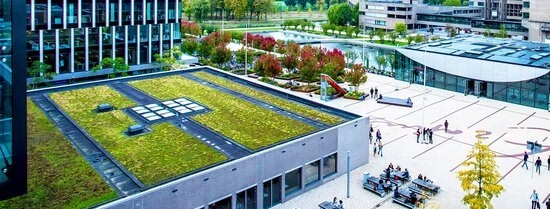
From research into child poverty that is directly informing municipal policy to a social enterprise making gene therapy affordable. And from reducing waste on campus to giving sustainability a more prominent place in the curriculum: EUR is showing in many different ways how research and education can translate into societal impact. This is evident from the Impact & Sustainability Report 2025.

For the second consecutive year, the report brings together EUR’s impact and sustainability reporting. It shows how the five impact domains set out in Strategy 2030 are taking shape in practice: from the resilience of our society to the responsible use of technology. Sustainability is not a separate chapter, but as one of our strategic themes woven throughout our education, research, collaboration with society and university operations.
From education to research: impact in practice
This translation into practice starts with education and research. In 2025, more than 10,000 students worked on societal challenges as part of their education, and 115 bachelor’s and master’s programmes were connected to real-life challenges through the networks and societal partners of Erasmus Verbindt. Seven faculty projects were supported to further embed sustainability in the curriculum.
In research, 38.1% of research output was linked to the Sustainable Development Goals (SDGs), while 89.7% was published open access. A total of 196 publications were identified as engaged research, in which researchers actively collaborate with citizens, communities and societal organisations. Three examples show what this looks like in practice.
Making children visible in tackling poverty
Within the impact domain ‘resilience and robustness of our society’, the Child Poverty research programme demonstrates what this means in practice. Rotterdam has one of the highest rates of child poverty in the Netherlands. Together with Rotterdam University of Applied Sciences, EUR researchers spent months following families and support professionals in four Rotterdam neighbourhoods to understand what does and does not work in an integrated approach to poverty. A photography project gave children the opportunity to show what gives them resilience. In 2025, the findings were translated into concrete policy recommendations, which are now actively being taken up by the municipality of Rotterdam and the National Fund for Children’s Aid.

Students and businesses working together on the energy transition
Within the domain ‘a just transition towards a sustainable society’, the Erasmus Centre for Energy Transition (ECET) brought together law, economics, business administration and governance in 2025 to accelerate the energy transition. Through the new, student-led Erasmus Energy Club, students were able to work directly on challenges from the sector through workshops and practical assignments. At the same time, ECET received funding to develop new learning programmes together with Rotterdam University of Applied Sciences and businesses for professionals in the Rotterdam port area, where energy, materials and climate issues intersect.
Affordable gene therapy for rare diseases
Within the domain ‘healthy society and accessible and affordable healthcare’, LentiCure demonstrates what this can achieve. This social enterprise of Erasmus MC is developing gene therapy for rare diseases at a socially acceptable price, in a market where commercial treatments can quickly cost millions of euros per patient. In 2025, LentiCure completed the design of gene therapy for Pompe disease and successfully completed an initial pilot production, partly thanks to support from the Prinses Beatrix Spierfonds. The aim is to treat the first patients in 2027.
These examples are very different in terms of content, but they demonstrate the same movement: societal challenges are being connected to EUR’s academic strength, disciplines and partners are working together, and knowledge is not only being developed, but also applied and shared.
Sustainability as a common thread in university operations
This collective commitment is also increasingly taking shape in the university’s operations. In 2025, the amount of waste decreased by 27.4% compared with the previous year, while Scope 1 and 2 CO₂ emissions fell by 24%.
At the same time, the report provides a more complete picture of EUR’s total carbon footprint. For the first time in ten years, emissions from student mobility have also been included in the reporting. As a result, the total reported volume of greenhouse gas emissions in 2025 is higher than in 2024. This expansion of the measurement methodology provides a more accurate picture of the total footprint and helps us work more effectively towards further reductions. Mobility remains an important area of attention.
Circularity is also increasingly taking shape. The renovation of the Tinbergen Building ranks among the 10% most sustainable building renovations in the Netherlands. The renovation includes, among other things, the reuse of materials from the original building and the use of materials with lower CO₂ emissions. In addition, EUR became the first university in the Netherlands to commit to the Planetary Health Diet across its entire campus. Together with all campus food and beverage providers, concrete targets have been agreed for 2030.

A sustainable organisation creates opportunities for development
At EUR, sustainability is explicitly about more than CO₂, buildings and resources: it is also about the kind of organisation we are. In 2025, more than 800 employees from all faculties and services took part in Active Bystander Training, aimed at recognising and addressing inappropriate behaviour. A further 166 academic staff members were supported in their development through the IDEA Center’s Advancing Inclusive Academia programme.
EUR also considers this part of making the university more sustainable: the way colleagues work together and are given the space to develop.
Working together towards a sustainable future
The report not only shows what was achieved in 2025, but also how impact and sustainability are increasingly becoming part of the way EUR works. Students are developing initiatives themselves, researchers are working with societal partners, and sustainability is increasingly being taken into account on campus when making decisions about buildings, mobility, food, biodiversity and resources.
About the report
The Impact & Sustainability Report 2025 provides an in-depth overview of progress towards EUR’s ambitions across its impact domains, as well as progress in the area of sustainability. The report highlights how researchers, educators and students make meaningful contributions, working together with the partners and communities around us. It also shows how research contributes to addressing interconnected environmental and societal challenges, drawing on the Sustainable Development Goals. In addition, the report demonstrates how EUR is putting its sustainability ambitions into practice through its campus operations, infrastructure and institutional culture.
Downloads
Want to know more? Read the full report
