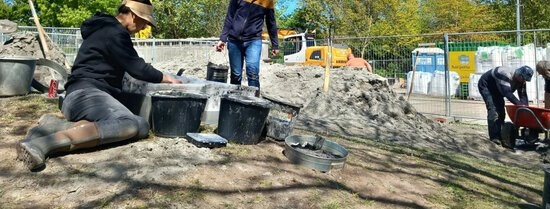
Thanks to a collaboration between the Natural History Museum Rotterdam, Grondboorbedrijf Hajtjema and Erasmus University Rotterdam (EUR), citizen scientists from the Tertiary and Quaternary Geology Working Group have been searching for fossils on the Woudestein campus.
For the past two weekends, an enthusiastic group of people gathered on campus around a large pile of sand, equipped with spades, sieves, mortar tubs and wheelbarrows. They sampled around 16 cubic metres of sand (around 75 bathtubs) in search of fossil shells. Every now and then an excited shout could be heard: ‘Wow, a complete Acila!’ or ‘Another beautiful Ringicula!’.

Ancient earth layers
The sand has come to the surface via a thermal energy storage borehole. Ground drilling company Hajtjema is drilling a 200-metre-deep geothermal well on campus, which will provide the Tinbergen Building with sustainable and reliable heating. “With such deep drilling, ancient earth layers and fossils come to the surface. Usually these are completely inaccessible, so this was a unique scientific opportunity!”, says Bram Langeveld, Head of Collections & Research at the Natural History Museum.
"a unique scientific opportunity!"
Bram Langeveld
Head of Collection & Research at the Natural History Museum Rotterdam

Two million years ago
The sand, which was deposited around two million years ago in an ice-cold and shallow primordial North Sea, mainly contains fossilized shells such as the mollusc Acila and the small snail Ringicula. In addition, the citizen scientists also found fossilized stingrays’ spines, fish vertebrae, crab claws and small sea urchins. Some of the species found still live in the North Sea or further north, but there are also extinct species among them.
Palaeontological heritage
“By preserving the fossils properly, the collectors are safeguarding palaeontological heritage, and by studying them in more detail, we learn more about a vanished ecosystem,” explains Bram. The fine grit that has been sieved from the sand undoubtedly contains even more remarkable finds, but this only becomes apparent after microscopic examination. This process can take up to a year of time.

- More information
Do you have any questions related to this news? Please contact Real Estate & Facilities via tomorrowscampus@eur.nl.
