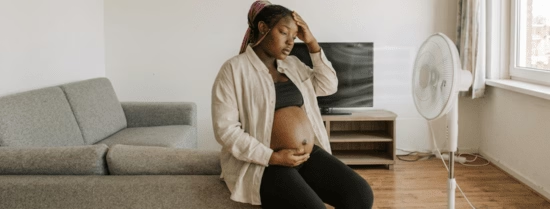
Pregnant people are especially vulnerable to heat, yet they rarely appear in heat plans or practical advice. In Rotterdam, researchers are examining why pregnant women receive so little heat advice and what healthcare providers, housing associations and the municipality can do to protect them.
During hot days, a pregnant woman in Rotterdam went to McDonald's. She was not there for a meal. The air conditioning gave her what her come could not: a place to cool down. She was one of the mothers researcher Merel Dap (Erasmus MC) spoke with for the Hot Homes project.
Other women sought relief in supermarkets or parks. Some slept in the living room because it was the least hot room in the house. Many lived in social housing, often on the top floor under a flat roof. Many described the problem in the same simple terms: 'My house just doesn't cool down.'
These experiences point to more than discomfort. They reveal a blind spot in how the city prepares for heat. In her conversations with policymakers and professionals, Dap noticed that older people and children were routinely mentioned as vulnerable groups during hot weather. Pregnant women were not.

A risk that is still underestimated
The lack of awareness surprised PhD researcher Medha Pfaff (Erasmus MC). 'I was really surprised that this information still felt so new to people,' she says. She also noticed that pregnancy was missing from the climate adaptation plans she reviewed.
There is already evidence that heat during pregnancy can affect birth outcomes. A 2025 nationwide study co-authored by Hot Homes project lead Jasper Been analysed almost 2.5 million births in the Netherlands. Each additional day during pregnancy with an average temperature above 20°C was associated with slightly higher odds of preterm birth, low birth weight and babies being small for their gestational age. The associations were strongest among households with a low socioeconomic position.
Pfaff is now working with more detailed weather data to examine how heat exposure differs between Rotterdam neighbourhoods. Dap adds the experiences behind those figures: where women live, what they do when their homes become too warm and which options are simply unavailable to them.

Advice cannot cool a top-floor flat
The women Dap interviewed said they had received little or no information about heat during pregnancy. That matters because they usually rely on their midwives for information during pregnancy. Yet several midwives told Dap that the findings on heat and birth outcomes were new to them too.
Dap says the midwives she spoke to were willing to share information, provided it was easy to use and did not add another time-consuming protocol. Their own practices can also become very hot, particularly in neighbourhoods with much social housing. Heat-related symptoms are difficult to recognise as well: swelling and shortness of breath can also occur towards the end of pregnancy.
Housing providers can also play a role in reducing heat stress among pregnant residents. In her conversations with housing providers, Dap noticed that some focused mainly on what residents could do themselves, such as keeping curtains closed during the day and opening windows once the air outside had cooled. One provider had fans and other cooling aids available for tenants to borrow. Almost none of the mothers knew this. A woman who asked whether air conditioning could be installed, and was willing to pay for it, eventually abandoned the request after a long process.
The result is a gap between advice and reality. A fan may no longer help above a certain temperature. Not everyone has relatives or friends with a cooler home. Even making a neighbourhood greener can be complicated: in Delfshaven, pipes and cables beneath the streets limit where trees can be planted.
'After nine months she is no longer pregnant, but then she has a small child in the house, and the house is still too warm'
Merel Dap
Erasmus MC
Pregnancy ends, but the hot home remains
One housing provider described pregnancy as a temporary vulnerability. But according to Dap, heat stress remains a problem long after childbirth: 'After nine months she is no longer pregnant, but then she has a small child in the house, and the house is still too warm.'
That exchange captures the policy problem. No single organisation can solve the problem. Healthcare providers, housing associations, public health services and municipalities all have a role to play. Each party sees part of the issue, but no single organisation can cool a home, redesign a street and reach every pregnant resident.
The responsibility can then slide back to the individual woman. She is expected to find the coolest room, use the windows correctly or go somewhere else. Those choices are much more limited for someone on a low income, living in an overheated flat without a nearby support network.

Putting the whole city in one room
The researchers have already brought mothers together with a midwife, the municipality, the municipal health service and a housing provider. Dap says the mothers valued being able to speak directly with people they would not normally meet. They felt heard, while professionals could compare what they knew and where communication was breaking down.
A policy lab is planned for autumn 2026 to continue that conversation. The researchers see the meeting as the beginning of a longer process: bringing together people who currently work separately, coordinating efforts across organisations and clarifying what short-term protection and longer-term changes would require.
Closing curtains at the right time may help, but it cannot repair a top-floor flat or create shade in a street. The researchers therefore argue that protecting pregnant women from heat must be treated as a shared responsibility, rather than left to individuals. After the baby is born, the hot home remains.
- Researcher
- Researcher
- Professor
- More information
Project: Hot Homes, Vulnerable Beginnings
People: Medha Pfaff, Meral Dap and Jasper Been (Erasmus MC)
Funding: A City Seed Grant from the Resilient Delta Initiative and a Sprint Grant from Healthy Start.
Timeline: The project is expected to run until October 2026; a policy lab is planned for autumn 2026.- Related content
- Related links
- City Seed Grant announcement
Nationwide study on prenatal temperature exposure and birth outcomes

