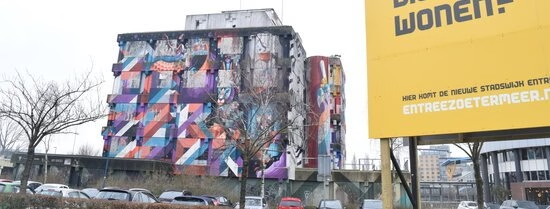
What makes a place feel right – or wrong? In her PhD research, Naomi Rommens is investigating the placemaking process: how we shape, experience and use places together. Placemaking is often seen as inherently positive: the creation of vibrant, inviting public spaces. But in practice, it can also exclude or divide people. Think of gentrification, where revitalised neighbourhoods displace existing residents, or of polarisation, where only certain groups participate in the process whilst others are left out.
To understand how placemaking can truly bring people together, this research project focuses on the concept of ‘sense of place’: the feeling that people attribute to a place. A sense of place is a key outcome of placemaking, but often remains abstract and elusive in both theory and practice.
Affect: More Than Emotion
To gain a better understanding of this, the research draws on the concept of affect. Unlike emotion (a short-lived, recognisable reaction to a stimulus), affect refers to more diffuse, often unconscious impressions and moods evoked by a place. Think of atmosphere, energy or subtle changes that determine how people relate to their surroundings. Affect flows between people and objects, shapes meanings, and colours how space is experienced.

The Challenge of Affect in Area Development
Affect is difficult to measure or define, and as a result is often overlooked in urban regeneration. In this research, affect is not treated as a clearly defined concept, but is used as a lens through which to understand how people relate to places, both physically and relationally. It helps to reveal how a sense of place emerges in everyday practices, and how placemaking can not only connect people but also alienate them. This gives rise to a critical approach to placemaking: one that looks beyond physical design and explores what a place does to people.
Sub-study: placemaking as an affective practice
An initial sub-study investigated how affect plays a role in placemaking. To this end, thirty walking interviews were conducted with residents, placemakers and local government officials involved in placemaking in three cities: Rotterdam (Buurtklimaatje), Zoetermeer (Entree) and Vlaardingen (District U). This research sought to understand how a sense of place arises, changes, but can also cause friction.
This inductive study revealed a typology of affect, comprising four forms of sense of place:

- Fused: unifying and close: "I felt lonely for years, but now I've really connected with the neighbourhood." (participant quote)
- Disruptive: fragmenting and close: "When I moved here, it felt as though I'd lost 100 IQ points just by packing my suitcase." (participant quote).
- Attractive: connecting but distant: "The area has potential. At least something's happening here." (participant quote)
- Repulsive: fragmented and distant: "I compared it to Chernobyl." (participant quote)
This typology shows that a sense of place does not arise spontaneously and is not always positive. It provides a framework for better understanding and guiding placemaking processes.
What contributes to bonding affection?
The study also identified three underlying factors that contribute to a sense of connection to a place:
Governance plays a crucial role in how placemaking is experienced. Not only because it guides decision-making, but also because it determines whether people feel recognised, involved and taken seriously. In Carnisse, the ‘Buurtklimaatje’ placemaking initiative fostered genuine participation, enabling residents to actively shape their environment. This led to a sense of connection to the place. In Entree and District U, by contrast, placemaking was primarily driven by policy, which actually evoked feelings of exclusion amongst residents. The temporary nature of projects also proved to be a factor: short-term initiatives without lasting support undermine trust and long-term engagement.
These conditions make it clear that affect is not merely emotional, but also structural and relational. By taking this into account, placemaking can become more inclusive and meaningful.
The full report can be downloaded below. Two academic papers on this study are currently under review and will be available here once published.
Follow-up research
In a subsequent sub-study, Naomi is investigating affective practices surrounding symbols and rituals in Oud Mathenesse, Rotterdam. In this way, she is working step by step towards a deeper conceptualisation of critical placemaking: a form of placemaking that truly connects people, because it takes the power of a sense of place seriously.
Researcher
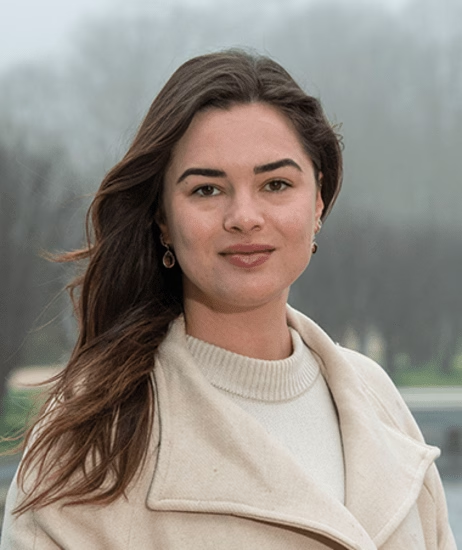 Drs. Naomi Rommens
PhD student
Promotors
- Dr.ir. Beitske Boonstra
- Prof.dr. Jurian Edelenbos
- Dr. Warda Belabas