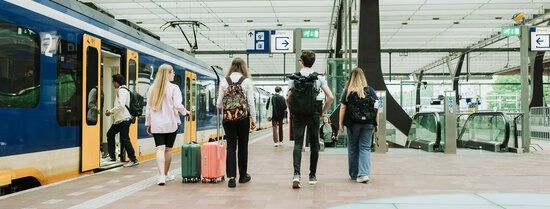
Erasmus University Rotterdam works together with Student Mobility to support international students in arranging transport in the Netherlands and across Europe. On this page you will find how to prepare your journey before arrival, how to travel to Rotterdam from the airport, and how to get around the city once you are here.
Arrange your travel before arrival: Student Mobility
Student Mobility offers two main services to make your journey easier:
- A student travel package (OV-pass, ISIC Student ID and bike options).
- Discounted train e‑tickets for travel within the Netherlands and across Europe.
Student travel package
With Student Mobility, you can get a discounted student travel pass, a global student ID and different bike options in one package. Student Mobility creates a personal discount profile and connects it to your public transport (OV) travel product, so you can travel more easily throughout the Netherlands.
You can choose the Student Mobility package that suits you best:
- Student Mobility OV-pass.
- ISIC Student ID.
- Bike.
- Combined package.
Order your package before arrival via Student Mobility and start your stay in the Netherlands fully prepared. You can collect your product during the International Welcome Day or one of the One-stop-shop days, or have it delivered to your Dutch address.
Discounted train e‑tickets in the Netherlands and Europe
Are you travelling to the Netherlands from your home country, looking for a train ticket after landing at the airport, or planning to explore Europe during your stay?
With StuMob (part of Student Mobility) you can access exclusive student discounts for international and domestic train travel. You can compare fares, book e‑tickets easily and enjoy a convenient, affordable and sustainable way to travel, all on one platform.
Getting to and around Rotterdam
The Netherlands is very well connected by air. Most international students arrive at one of these airports:
Amsterdam Schiphol Airport
- The largest airport in the Netherlands.
- About 40 minutes by train from Rotterdam.
- Easiest way to get to Rotterdam: train (direct Intercity trains run frequently).
Rotterdam/The Hague Airport
- Smaller airport close to Rotterdam.
- Easy to reach by bus and metro.
Other airports nearby
- Eindhoven Airport (NL)
- Brussels Zaventem and Brussels Charleroi (BE)
From these airports, you can reach Rotterdam by train.
Once you arrive, we strongly recommend getting a bike. Cycling is the easiest way to get around Rotterdam and the surrounding areas, although public transport is also very efficient, it's more expensive.
You can:
- Buy a new or refurbished bike.
- Buy a second‑hand bike (a reasonable second‑hand bike will cost around € 150).
- Rent a bike, for example via Swapfiets, which includes full support if your bike needs maintenance or is stolen.
Second‑hand bikes are available at most bicycle shops and at the bicycle shelter at Rotterdam Central Station. We strongly advise against buying a very cheap bike on the street, as these bikes are usually stolen. If it sounds too good to be true, it usually is.
There is a bicycle repair shop on the ground floor of the Polak Building (between the Sanders Building and Langeveld Building) on campus Woudestein. Visit the shop if you have any problems with your bike.
Check-in and check-out system
The Netherlands has an extensive public transport network with trams, metro services, buses, ferries and trains. NS is the national train company in the Netherlands and RET is the local transportation company in Rotterdam.
To pay for your trip you can use:
- An OV-chipkaart
- Your debit or credit card
- Mobile pay on the readers located at the station or on the vehicle
You scan your card or phone on the card readers at the station or inside the vehicle.
It is very important that you always check in and check out. You do this by holding your card or phone against the reader on platforms (for trains and metro) and on board the vehicle (for buses and trams). You must also check in and out when you change to a different line or mode of transport. Do not forget to check out, if you do, you will be charged extra costs.
Travel apps
The app 9292 (available in English) is a convenient way of planning your journey.
- 9292 at the iOS App Store
- 9292 at the Google Play Store
Student travel product (Dutch student finance)
Some students may be eligible for the student travel product. This travel product is part of the Dutch student finance system. It enables you to travel by Dutch public transport for free or at a reduced rate, either during weekdays or weekends.
Note specific requirements apply and that only students with a Dutch nationality, EU/EEA and Swiss students, as well as some students with a residence permit can apply. You can find all details on the governmental DUO website.
Driving licence validity and exchanging
Driving licence rules depend on how long you stay and where your licence is from:
- If you stay in the Netherlands for up to 3 months and are not registered at any Dutch municipality, your current foreign driving licence is usually valid.
- If you stay longer than 3 months and are registered at a Dutch municipality, your foreign driving licence is typically only valid for a limited period (often around 6 months). After this period you may need to:
- Exchange your licence for a Dutch driving licence, or
- Take a driving test in the Netherlands.
Citizens from the EU/EEA and some other countries can often exchange their driving licence directly. Others generally need to pass a Dutch driving test.
Driving licence regulations can change and may depend on individual circumstances. For up-to-date information, always consult:
- The municipality
- The website of Centraal Bureau Rijvaardigheidsbewijzen (CBR): www.cbr.nl (in Dutch)
Navigating the Dutch driving system
A team of international EUR students founded DriveDutch. A website with a mission: to make the Dutch driving education system accessible and understandable for international students in the Netherlands. The platform provides comprehensive resources, guides, and tools to help international students prepare for their theory and practical exams, find reliable driving schools, and understand the nuances of Dutch road culture.