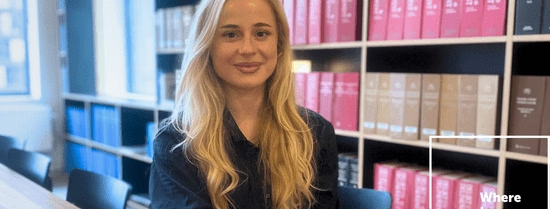
When Saar Kroone first started out as a tutor, her attention was largely on the content. Focused on conveying learning objectives, literature and case studies. But the more time she spent in front of the group, the more she noticed her focus shifting. "You become much more preoccupied with the group itself," she says. "How do I make sure everyone is engaged? How do I make sure everyone feels confident enough to speak up?" What began as conveying subject matter gradually became guiding a group. Now she takes this one step further by combining her work as a tutor with that of a study coach, a combination in which, by her own account, she truly comes into her own.
In our series *Where Law Meets (your) Business*, we show the different ways colleagues put their expertise to use: in research, education, support, and in the connection between law and society. We speak with them about their careers, their motivations, and the moments when their work truly takes on meaning.
"I never would have mapped out this route"
Anyone who had followed her academic trajectory might have predicted a different path. "I never imagined I'd be working here as a tutor," says Saar Kroone. "And certainly not as a study coach. But it's precisely in that combination where I really come into my own." Saar studied law and tax law at Erasmus University, completed her master's here and began a traineeship in legal practice. In her own words, she had an image of "going high and far" in her head, working at a large firm, building a career.
"From an early age I had a strong drive to build a career. Specifically when it came to working at a big firm." During her traineeship, she realised that environment suited her less naturally than she had expected. "I noticed that I don't perform at my best in a setting where everything revolves around competition." drive to advance her career. Specifically when it came to working at a large firm.” During her internship, she noticed that that environment didn't suit her as naturally as she had thought. “I realized that I am not at my best in an environment where there is a lot of competition.”
"In legal practice, you're legally opposed to someone. You win or you lose." That realisation deepened as her work introduced her to concepts such as haves and have-nots and one-shotters and repeat players. "The law assumes formal equality, but in practice parties are rarely equally equipped. A large organisation with three lawyers up against a small business. I wanted to help people, but I started asking myself: how equal is this, really?"
During that same period, her father, also a lawyer, was diagnosed with a terminal illness. "I wanted to step away from that world for a while. It felt too loaded," she says. She left legal practice and went to work in consultancy. It was this detour that brought her back to the university, and to the classroom.
From wanting to win to guiding others
"I might never have imagined becoming a tutor, but the more I did it, the more I realised I'm actually well suited to it." As a tutor, Saar guides tutorial groups in the first year. In the beginning, teaching is about the content for her: conveying learning objectives, literature and discussion points. But the longer she stood in front of the group, the more she began to notice that something beyond knowledge transfer was taking place.
"Over time your focus shifts. You become much more preoccupied with the group itself. How do I make sure everyone is engaged? How do I make sure everyone feels confident enough to speak up?" And that attention is perceptible within a group. Where silences used to linger and eyes stayed fixed on the table, she now sees a hesitant hand going up more often, a student venturing to put something into words. Small moments, but for Saar they say a great deal. For her, teaching is about activation.
Being there precisely when a student gets stuck
Alongside her role as a tutor, Saar works one day a week as a study coach. As a tutor, she sometimes has to be strict. The system only works if students come prepared. As a coach, she can slow down. "Then I can really listen. I can ask: what's making it not work right now? And how do we make sure it works next time?" Together with her colleagues Bobbie and Marvin, she supports students who are struggling with their approach to studying. Femke coordinates the team. Femke is the coordinator of the team.
"A lot of students find their way to us through a lecturer or a study adviser," she explains. "We don't have a fixed desk where you can just walk in. So it's important that colleagues know we exist." Lecturers who notice that a student is struggling with study skills or structure can refer them to the study coaches.
Sessions typically last half an hour and take place in person or online. Sometimes it's a single conversation; sometimes several sessions follow. The study coaches also run workshops on study skills, covering topics such as studying efficiently, distinguishing main points from secondary ones, and working with open-ended and multiple-choice questions.
The questions students bring often seem practical: "How do I write a summary? How do I use my statute book?" But according to Saar, there's frequently something else beneath the surface. "For instance, students with ADHD or autism who find it difficult to make choices. Or students who think: everything is important, I need to know everything. That's where they can get stuck."
Distinguishing main points from secondary ones sounds like a study skill. In practice, it's often a matter of confidence. Daring to choose. Accepting that you can't take in everything at once. Study coaching is not a substitute for psychological support, she emphasises. "When there are genuinely serious issues at play, we refer students on. But many students benefit from having someone look at their approach alongside them."
Where Law Meets (your) Business
When does she feel that her work makes a difference? Saar pauses to think. "When a student who was completely stuck suddenly says: okay, maybe I can do this after all." Not a case won, but a shift in confidence that can genuinely move a student forward.
That she would find her place here, within Erasmus School of Law, was not something she had anticipated. Now it feels logical. "It's really only become clear over time that this suits me better than I ever would have thought." What she hadn't found in her earlier work, she finds here. "I noticed that I don't function as well in an environment where everything revolves around competition. Here, the competition is much less present. You're focused on development. On growth. And I get a great deal from that."


