The history of Erasmus School of Law, formerly called the Faculty of Law, is our story of vision, innovation and dedication. From our establishment and first students in 1963 to international recognition and major (scientific) developments, our School has developed into a dynamic and progressive academic community over the years. We are GROOS of that. Our history strongly determined who we are today: committed, with courage that is so strongly linked with Rotterdam and a constant drive to connect law with other disciplines and our environment. This is a tribute to our past: that what has made us firmly rooted in the culture and city of Rotterdam and a safe haven for (future) lawyers, tax specialists, criminologists, researchers and everyone who considers Erasmus School of Law a home port.

The establishment of the Faculty of Law
1963
On 17 December 1959, Piet Sanders, a renowned corporate law and arbitration law lawyer, convened with his recently formed Senate committee. The goal of this committee was to create a law faculty in Rotterdam, which would offer a legal learning environment with components from economics and sociology. Four law faculties in the country immediately took up arms. After all, they thought that law was not a social science. The Minister and the Parliament nevertheless agreed to the blueprint presented by Sanders.
In September 1963, the first cohort of students started their studies at the brand-new Rotterdam Faculty of Law, part of the Nederlandse Economische Hogeschool. The students followed lectures on the History of Law with Professor Kunst, the first Professor to be appointed, in addition to sociologically and economically oriented subjects. The nominal study period was four years and three months, with a one-year candidate phase. This proved to be too ambitious. Even before the first student left the faculty, the study period was increased to five years.
The rights pioneers
1963-1967
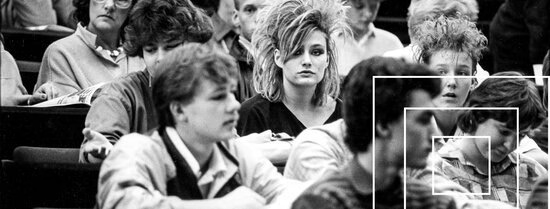
When the doors of our law faculty opened in 1963, 56 students were ready to embark on their academic adventure. Although this number of students seemed modest in the national context, we were satisfied. It was a starting point on the road to growth. In reality, the strength of the brand-new faculty turned out to be the small number of students. With the possibility to provide a small group of students with intensive guidance and personal contact. And they succeeded: the pass rate in the first year of was no less than 88%. In this way, cautious doubts about quantity made way for great quality after just the first year.
Amid the lecture benches was the Frisian Hans Meijer. After the municipal gymnasium in Leeuwarden and a year of military service, Meijer enrolled in 1963 as one of the 56 law pioneers in Rotterdam. A little over four years later, Meijer was the first to complete his study at our faculty. Above-average speed, even nationally. In all likelihood, this success was partly made possible by the intimate and intensive study nature that characterised our faculty.
Sources: NEH 1963-1973, Delpher

A woman with vision and direction
1969
In late 1969, Rotterdam’s law school experienced a historic moment with its first PhD candidate. What made this milestone even more extraordinary for its time was the fact that a woman wrote the dissertation, Leonie Susanne Charlotte Heyning-Plate, who was born and raised in Rotterdam.
Heyning-Plate wrote her dissertation Eigen richting tot zekerheid under the guidance of rector magnificus Jan Wiek. On a Thursday afternoon in November, she defended her research on the legal concepts 'de exceptio non adimpleti contractus’ and the right of retention, aimed at suspending or refusing performance under contract when the other party fails to fulfil its obligations. Her work contributed to understanding these mechanisms and their role in ensuring certainty in contractual relationships.
This extraordinary promotion led many to speculate about Heyning-Plate’s plans for the future. When asked about a possible legal career, she humorously stated, “My husband is a lawyer, so I should work in his office. I cannot impose legal action against him, can I?!” Nevertheless, Heyning-Plate determined her ‘own direction to certainty’. Starting in 1975, Heyning-Plate worked as a judge for almost a decade and later as a delegated judge at the District Court of The Hague. In 1984, she was appointed judge at the Court of Appeal, and in the early 90s, she added the vice-presidency of the same court to her career.
Similar milestones were celebrated years later, with the appointment of Esin Örücü as the first female Professor in XNUMX and in XNUMX, when Suzan Stoter was appointed as the first female Dean at Erasmus University Rotterdam.

From P70 to the ZKK lawyer
70s
After five years of education, it was time for an evaluation. Both the curriculum and didactics were discussed at a plenary meeting in March 1969, attended by ten lecturers and forty (!) students. In line with the spirit of the times, the governance structure was also critically (re)considered.
A note from Piet Sanders led to the curriculum Programme 70, or P70. Influenced by Professors Jack ter Heide and Louk Hulsman, it was decided to focus on training the basic lawyer, who connected legal knowledge and skills with social science insight. The traditional image of the lawyer as a scribe with their nose in a law book was considered passé. While the Minister wondered whether lawyers were still being trained in Rotterdam, the ZKK lawyer (independent, critical, creative) became the unique selling point of the faculty.

A historic merger
1973
On the night of Wednesday, 31 January to Thursday 1 February 1973, precisely at 0.00 hrs., the Erasmus University Rotterdam was born. The overnight decision made the flags of Rotterdam City Hall wave proudly the following day. The private foundation de Nederlandse Economische Hogeschool and state institution de Medische Faculteit Rotterdam would continue together via a special law (lex specialis). Despite their different history and cultures, it was decided to form this union, overcoming geographical and organisational differences. The merger had been encouraged by the Rotterdam City Council for years and symbolised a commitment to administrative efficiency and scientific progress. At the start of the first full academic year in 1973-1974, 4414 students enrolled - a promising start for the new university. In addition to the Faculty of Economics, Social Sciences and Medicine that were part of the university at the time, many of these students started at the Faculty of Law.
Sources: book ‘Erasmus University Rotterdam 1973 – 1993’ and Delpher.

A top programme in Law and Economics
1990
The history of the European Master in Law and Economics (EMLE) takes us to the year 1990. Stimulated by a newly started exchange programme between the law faculties of Rotterdam and Ghent, Oxford and Paris-Dauphine also saw potential in a small-scale, international education programme. The four partner universities provided the promising programme. Twenty students started the programme, which soon grew.
Over thirty years later, EMLE has ten member universities, from Rotterdam to Rome and from Arizona to Mumbai. The Master gained international recognition when it was selected as one of the top Joint Masters by the European University Association in 2003 and successfully joined the European Union's prestigious Erasmus Mundus programme in 2004, in which it has been selected continuously ever since.
More than 2,000 students from 95 countries have now completed EMLE, and those who graduated after 2018 have a joint degree in their pocket. The programme directorate alternates between the universities of Hamburg and Rotterdam. With a hallmark of excellence and a staff with an exceptionally high level of expertise, according to a recent accreditation, EMLE is home to one of the largest groups of renowned Law and Economics researchers in the world.
In 2004, the establishment of the joint PhD programme EDLE (European Doctorate in Law & Economics) by Erasmus University Rotterdam (Netherlands), the University of Bologna (Italy) and the University of Hamburg (Germany) followed.

Tax specialists with clear characteristics from Rotterdam
1991
In 1960, building Dean Piet Sanders had proposed three majors: Constitutional Law, Private Law and Tax Law. This was too ambitious: Minister Cals of Education, Arts and Sciences granted Leiden University the monopoly on Tax Law studies.
However, the passion for tax law kept simmering and the fire ignited in the late 80s due to three scholars from the Tax Law Section. Jan Christiaanse, Jan Monsma and Henk van Arendonk successfully pointed out the added value of tax specialists with characteristics from Rotterdam. In September 1991, around 75 students started studying Tax Law. Under the auspices of ‘fiscal builder’ Van Arendonk, the study of Tax Law grew stronger and stronger and, anno 2024, is established on a solid foundation at Erasmus School of Law.
Sources: input Louis Visscher & Wicher Schreuders, EMLE website.

Criminology flourishes
2001
In 1963, Louk Hulsman and Peter Hoefnagels infused Rotterdam Criminal Law with socio-critical, international and criminological insights. For a long time, under the wings of Hulsman and Hoefnagels, Criminology formed a modest part of the legal curriculum in Rotterdam. In doing so, they laid the foundations for an independent discipline, which flourished in the 90s underCyrille Fijnaut, the criminologist from Leuven.
It was only in 2001 that the quiet rise of Criminology was officially recognised with an independent programme in Rotterdam. Crime was a hot topic, and politicians called for answers to new societal questions. The step towards an independent study programme was taken under the leadership of criminologists Henk van de Bunt and René van Swaaningen in cooperation with the VU Amsterdam and Leiden University. The programme's success exceeded all expectations, resulting in rapidly growing student numbers and a numerus fixus. Over the years, Erasmus School of Law has developed a distinctive empirical profile that focuses on youth, culture and organised crime. All these developments led to the succesful IMARC programme (International Master's in Advanced Research in Criminology) established in 2019.
Sources: book Erasmus School of Law and its predecessors, input René van Swaaningen & Delpher.

A new direction in education
2012
After observing an innovative teaching model at the Law School of York University (United Kingdom) and the success of the Rotterdam Psychology programme with a similar system, Erasmus School of Law ushered in a new era in 2012: the Erasmus Law College (ELC). The traditional lecture rooms were partly replaced by small-scale teaching groups, where students were challenged, under the guidance of a tutor, to become problem-based learners, in other words, to work independently with literature and case studies. Under the motto of active academic learning, they embraced the belief that knowledge is not (only) transferred in the classroom but is actively acquired when students take ownership. Students attended teaching groups, lectures and practica to prepare themselves for professional practice. The new system attracted the attention of students from all parts of the Netherlands soon after its introduction.
Sources: book Erasmus School of Law en haar voorgangers, internal documents ELC, online EUR file with information PGL

Erasmus Graduate School of Law: front runner in the Netherlands
2012
With the establishment of Erasmus Graduate School of Law (EGSL) in 2012, the image of the PhD candidate working solitarily on their dissertation was a concept of the past. EGSL brings doctoral students together and offers an educational programme to help them in their PhD trajectory. Particularly in the first year, they receive intensive supervision. A digital educational programme has been set up for external PhD candidates and part-timers. The PhD candidates can contact EGSL for support and meet each other regularly. Much attention is paid to the personal well-being of the PhD candidates, who come from all parts of the world. The result: high-quality dissertations that have even won awards.
The PhD candidates do not keep their results to themselves. At the end of their first year, they present the results at Review Day. The success has not escaped the attention of the reviewing research assessment committees. Official evaluations have identified EGSL as best practice and even as one of the front-runner Graduate Schools of Law.
A new credo
2013
Legal science does not stand on its own. It is intertwined with its environment. Over the years, this symbiosis between science and practice has come to form the soul of Erasmus School of Law. This began in the last century with the ideas of founding father, Piet Sanders. As part of the Nederlandse Economische Hogeschool, the faculty had a strong economic slant from its ontset. Sanders foresaw that law could not be considered in a vacuum: the economic and social context gave the law meaning. Sanders encouraged students to think about these contexts and the broader social implications of law.
Based on this vision and with the new name ‘Erasmus School of Law’, the motto ‘Where Law Meets Business’s was created in 2013.
Sources: website Erasmus School of Law & video Arnoud Houweling.


The Academy of the Future
2018
The overall project was named The Academy of the Future. Its elements included contemporary education, a holistic research vision and a new homebase. Our established L-building – carrying the minimalist name had been replaced by Sanders Building - was given a new dimension in 2013-2015. Led by Dean Suzan Stoter, the outline of a transparent School emerges where collaboration in all forms is encouraged.
It was renowned architect Jo Coenen who shaped the transformation of the building designed by his teacher Wim Quist. While staff and students were accommodated elsewhere on campus, construction workers worked hard to create the new Sanders Building. Hans Franssen designed the colorful interior, assisted by visual artist Ilja Walraven and Professor Helen Stout. By 2018, all colleagues had found their new place in the renovated Sanders Building.


