Asking an organisation about the personal data held about us is at the core of data protection rights. Found in Article 15, this is a practical tool that the GDPR offers. In practice, using it has been increasingly covering other purposes, which may not always be legitimate.

Written by: Larisa Munteanu
External PhD Researcher, Junior Fellow at Erasmus Center of Law and Digitalization
These requests are sometimes used as a tactic in an employment dispute or as a less expensive way to gather evidence for litigation. They are even sent in bulk to put pressure on an organisation. The GDPR already lets controllers refuse requests that are “manifestly unfounded or excessive” (Article 12(5)), but that threshold is vague, and organisations apply it very differently in practice.
The Digital Omnibus
This point was (more or less) addressed by the European Commission in November 2025 through the Digital Omnibus, a package meant to simplify EU digital rules. One of its amendments would officially regulate abusive access requests as requests submitted for purposes other than data protection. The proposal faced strong criticism on grounds of affecting the exercise of a fundamental right and on potential contradictions with EU jurisprudence. The European Data Protection Board and the European Data Protection Supervisor also expressed criticism about the proposal, but more nuanced. Essentially, they emphasise that abusive intention should be taken into account.
The collateral use of access rights with an intention that may be abusive is the core of my recent paper. Therefore, I argue that the right of access should be analysed through a distinction between abuse and misuse, drawing the line at intention. A request made with the intention to harm is abusive; a request pursuing a lawful purpose that lies outside data protection is a misuse of the right, and should still be accepted. By reading Article 12(5) together with Article 15 of the GDPR, I set out an interpretative framework that separates these two situations and allows both the Digital Omnibus and the EU acquis to co-exist. I have relied on data protection scholarship, the legal theory of abuse of rights, reports by specialised organisations and case law from national courts and the Court of Justice of the European Union.
My aim is to let the legislator tackle genuinely abusive requests (which should not be tolerated) without undermining existing case law and legislation. This should also avoid offering controllers a new opportunity for abuse. If we fight abuse of rights, it should work for both parties. Easier rules should not lead to weaker rights.
Recognition and beyond
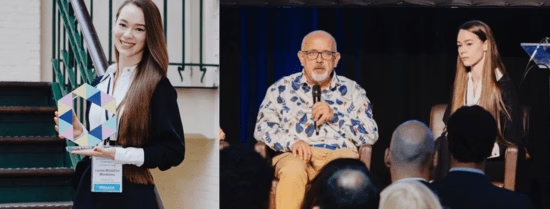
On 13 October, my paper won the “My Data is Mine Award” at the 10th Brussels Privacy Symposium, organised by the Future of Privacy Forum. The award represents one piece of a broader project, called Consumer Empowerment Project, led by Euroconsumers, a group of consumer protection organisations. I received the award from Wojciech Wiewiórowski (the European Data Protection Supervisor) and Marco Scialdone (the Head of the Litigation and Academic Relations Department at Euroconsumers). This year’s symposium focused on the Digital Omnibus and I was glad to contribute to a debate that is still very much open.
For me, this award confirms that years of study, competitions, and genuine passion for this field do add up. During this time, the constant support and motivation of my parents and loved ones has meant the world.
The topic is close to my doctoral research at Erasmus School of Law. My PhD, supervised by prof. dr. Klaus Heine and prof. dr. Koen Swinnen, looks at how companies reject GDPR requests that may conceal malware attacks. Alongside my research, I run my own firm, Protector PriVit, allowing my academic and professional work to continuously inform one another. I am also a frequent trainer at the European Institute of Public Administration, at the invitation of which I delivered a training session at the Court of Justice of the European Union.
My commitment to law, technology and international collaboration has been recognised on the global stage on several occasions. In 2021, I was named “Ignite Talk Queen” at the Youth Innovation Competition on Global Governance at Fudan University, following my proposal for a global convention at the intersection of data protection and artificial intelligence. In 2022, this was followed by the “Best International Future Lawyer Award”, presented by the International Association of Young Lawyers in Singapore.
And the journey continues! I am honoured to be one of the six shortlisted leaders for the International Leadership Excellence category of the NOVI Awards, which will be celebrated on 20 November in London.
- PhD student
- More information
A video of the award ceremony is available at YouTube. The paper that earned Larisa the prize is accessible at cep-project.org
