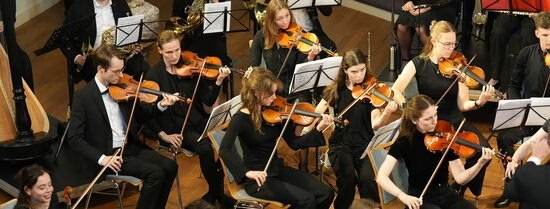
What do you do when life forces you to choose between surrender and resistance? In this concert, grand gestures, hidden pain and indestructible energy resound in three works that look fate straight in the eye. An evening in which the orchestra leads you from restrained tension to an overwhelming finale.
- Date
- Thursday 10 Dec 2026, 20:15 - 22:00
- Type
- Performance
- Location
Bergsingelkerk – Bergsingel 150, 3037GM Rotterdam
The Rotterdam Student Orchestra and cellist Ade Nicolas present an evening full of tension, emotion and great melodies. From Beethoven’s defiant hero to Dvořák’s intimate cello and Tchaikovsky’s gripping struggle with fate: three iconic works in which despair and hope constantly alternate. Yet these works are not stories of powerlessness. The music resists with courage, tenderness, anger and, ultimately, the determination to carry on.
Soloist: Ade Nicolas
Conductor: Coen Huisman
The concert opens with the “Egmont” overture by Ludwig van Beethoven. An admirer of Johann Wolfgang von Goethe, Beethoven (1770–1827) gladly accepted a commission to write incidental music, including an overture, for the poet’s stage play Egmont (first published in 1788). In the play, set in Brussels on the eve of the Eighty Years’ War, popular Count Egmont is leading Dutch nobility together with William of Orange in opposition to Spanish rule, but is imprisoned by the Duke of Alba and eventually sentenced to death. Beethoven’s music, first performed in 1810, captures the tragic end of its hero, without abandoning hope for victory.
In 1895, Antonín Dvořák’s (1841–1904) Cello Concerto in B minor was published. Dvořák wrote the concerto during his three-year residency in the U.S. Unlike other works written before it, the concerto does not seem to be influenced by American styles. It follows a traditional three-movement form and brings together virtuoso playing, symphonic detail, and rich contrasts. The concerto is also deeply personal: in the second movement, Dvořák included the melody of his song ‘Lasst mich allein’, a dedication to his sister-in-law and first love, who was very ill. After her untimely death in 1895, he added another quote of the song in the final movement, with the surprising use of a solo violin.
Pyotr Ilyich Tchaikovsky (1840–1893) wrote his Symphony no. 5 in 1888. While Tchaikovsky left an early sketch with ideas of bowing to fate, lurking doubts, and self-reproaches – possibly reflections on his homosexuality –, the finalised symphony does not appear to follow a programme. It uses, however, a characteristic, recurring ‘motto’ theme that repeats throughout the four movements, while also continuously transforming, sometimes radically. Sadness and tragedy emerge from the music, and it is safe to say that while writing the symphony, Tchaikovsky was bemoaning his own fate. Nevertheless, the triumphant finale of the fourth movement suggests that not all hope is lost.
More information about RSO
The RSO is a symphony orchestra for students and young professionals from Rotterdam and its vicinity, and combines ambitious classical music with the energy of a new generation of musicians.
More information: www.nu-rso.nl
More information about Ade Nicolas
Indonesian cellist Ade Nicolas is a soloist and chamber musician. His musical work focused on broadening the horizons of the cello repertoire.
More information: www.nicocellist.com
- More information
Date: Thursday 10 December 2026
Time: 20.15 - 22.00 hours
Location: BergsingelkerkTicket information
Students: € 7.50
Other visitors: € 10.00
Free entry for minors.Organised by Rotterdam Student Orchestra in cooperation with Studium Generale.
- Related links
- Follow the Studium Generale newsletter!
