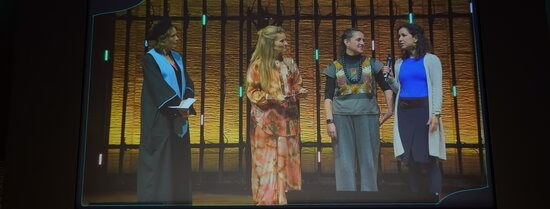
This year’s FAME Athena Award winners are Dr. Ana Uribe Sandoval and Dr. Katarina Putnik for the programme Advancing Inclusive Academia. ''Through empathy, openness, and inclusive leadership, you have built bridges, strengthened communities, and enhanced the feasibility and impact of institutional change''.
With the Athena Award, employee network FAME - Females in Academia Moving towards Equity - recognises and celebrates colleagues and students promoting gender equity.
A space where people feel safe
The FAME Athena Award was presented to Dr. Ana Uribe Sandoval, Senior Lecturer at ESHCC and programme lead for Advancing Inclusive Academia, and Dr. Katarina Putnik, Manager of IDEA Center, during the Dies Natalis by professor Liesbeth Noordegraaf-Eelens, Dean at ESPhil: ''Within the Advancing Inclusive Academia programme, you have created a space where people feel safe enough to identify and examine the challenges and barriers they face at EUR. Through empathy, openness, and inclusive leadership, you have built bridges, strengthened communities, and enhanced the feasibility and impact of institutional change.''
We interviewed Ana and Katarina on the programme Advancing Inclusive Academia, about winning the award and about working on equal opportunities at EUR.

What does winning this award mean to you?
Ana: ''It is very exciting to get recognised by the colleagues that we do the work for. Advancing Inclusive Academia is an example of institutional commitment to equal opportunities. Furthermore, we have always tried to make it a welcoming and caring space for all participants. We are proud that colleagues feel supported and helped, and winning this award gives us more energy to continue doing what we do.''
Katarina: ''I couldn’t agree more. We are honoured that what we do to make EUR a more inclusive university, is recognised and appreciated by the community.''
In working on the programme Advancing Inclusive Academia, what are you most proud of?
Katarina: ''That we have built an open, supportive environment where we can be our full selves, show our doubts and vulnerabilities, and being lifted and supported by each other, while at the same time working on the institutional level to make organisational practices more transparent, fair and inclusive.''
Ana: ''Yes! The duality of, at the same time, creating a soft and brave space for colleagues and having the chance to give back information to EUR as an institution to really push for change. We have the chance to discuss the challenges of career growth directly with our colleagues, and then we have the spaces to bring those experiences to the Executive Board, deans, and HR representatives, who have the influence to change things within EUR.''

''We receive messages by participants filled with hope and joy letting us know that they made a change in their career or are celebrating a milestone in their personal life.''
Dr. Ana Uribe Sandoval
Senior Lecturer at ESHCC and programme lead for Advancing Inclusive Academia
What is the biggest compliment you got for the programme Advancing Inclusive Academia?
Ana: ''We receive messages by participants filled with hope and joy letting us know that they made a change in their career or are celebrating a milestone in their personal life. That news is shared with us with pride, and people make us feel co-participant on their road. The biggest compliment is having a network that shares with us personally, not only hardships, but also discoveries and new stages in life. Those bonds will last for a very long time for all of us.''
Katarina: ''That the programme helped participants believe in themselves again. That the questions they had, or struggles they experienced, were more common than they thought. We work on bringing these signals and processes that do not work transparently, or fairly, back to the organisation. We share our insights and recommendations for improvement with the Executive Board, deans, HR business partners and Faculty Diversity Officers. Throughout the years we have been touched by the positive feedback we got from participants. It confirms why we need programmes such as Advancing Inclusive Academia.''
Quotes by participants of Advancing Inclusive Academia
''The whole journey, including the reviewers’ feedback, has been a healing process for me. It has also been an encouraging and enlightening experience. The reflections the process led us to have, have been extremely valuable.''
''The programme helped me tremendously: encouraged by the programme, I applied for a position - I took the plunge. And look at that: I got the job. Thanks for helping me grow.''
''I have enormous appreciation for the programme’s structure, the presentations, lectures and dialogues, the various initiatives that have been taken (for example, to clarify criteria for promotion), and the positive, constructive and highly engaged role played by everyone involved.''
''Thank you, thank you, thank you for bringing us together, despite the competitive nature of promotion. I appreciate it more than I can put into words.''

What do you see as a challenge for working on equal opportunities at EUR?
Katarina: ''Changing the system is the biggest challenge because the system is resilient. Just an example: the reality of academia is that competition is large. There are many, many wonderful, clever, hardworking colleagues, who are a great asset for the organisation and who are ready for the next step. Yet, there is more talent than positions. On the road to promotion, bias, privilege and lack of transparency can play an important role. The challenge remains how to ensure that things that are not relevant for one’s position stop playing a role in it. We have been working on these aspects for years, and we see progress, but I feel it is something we have to keep drawing attention to. It is not something one does once. Creating equal opportunities needs continuous attention.''
Ana: ''I think the biggest challenge is the sense, for some, that we have “done enough”. Equal opportunities should always be incremental and directed to the new realities in front of us, so it is an effort that should never end. In this sense, having long term financial and institutional support for initiatives like Advancing Inclusive Academia is crucial to ensure that long-lasting and meaningful change happens.''

''In this journey, each one of us can do something, within our own circle of influence, to improve equity.''
Dr. Katarina Putnik
Manager of IDEA Center
Is there something you would like to say to inspire others working on equal opportunities at EUR?
Ana: ''Equal opportunities are built in big projects but also in small gestures. We invite all our colleagues to make small changes and accommodations every day to make space for others. To freely quote Maya Angelou: ‘the reason to get some kind of power is to open doors and spaces for people that are not already there’. The path to equal opportunities is an everyday effort, and we will see our workplace change when we have kindness and care for the people who work around us and with ourselves.''
Katarina: ''We believe in the power of community, sharing knowledge and resources. In this journey, each one of us can do something, within our own circle of influence, to improve equity: speak out against stereotypes and microaggressions, use our own axes of privilege to be an ally. And always: be kind and caring.''
- Associate professor
- More information
Press related questions?
Please contact Team Press at ESHCC by telephone 06 24 57 89 59 or by email: haven@eshcc.eur.nl.
- Related content
- Related links
- More about Advancing Inclusive Academia


