Health Economics is not merely about abstract models or policies for Jacqui Simpkin. For her, the subject is deeply personal. 'I was 14 when my mum got ill', she says. 'And she passed away when I was in my final year of high school.' It was then, witnessing the realities of care, that Jacqui’s interest in health began. Growing up in Auckland, New Zealand, she initially imagined herself becoming a doctor, but that changed quickly once she started studying medicine.
'I realised medicine wasn’t for me', she laughs. 'Too gory. We had to work with cadavers in first-year health sciences, and that was… confronting.' What stayed with her instead was genetics, and a growing desire to understand health beyond the individual patient. Now she is doing her master’s in Health Economics in Rotterdam, supported by an Erasmus Trustfonds scholarship.
Why the combination of health and economics?
'At the University of Otago, I did two undergraduate degrees: science, majoring in genetics, and commerce, majoring in economics. At the time, I didn’t know how those fields would come together. It honestly wasn’t planned. I just followed what interested me and what I thought might help me find a job. The turning point came in my final year, when I took a health and education economics course. That was the lightbulb moment. I suddenly realised: this is where my interests intersect. Health economics asked the kinds of questions that mattered to me most, especially the morally complex decisions around which medicines are reimbursed, and who gets access to care. It fascinated me that you could use economic modelling to inform decisions that have real consequences for people’s lives.

In New Zealand, pursuing health economics proved difficult. There were few specialists, limited master’s options, and no clear pathway into the field. So I started working. For nearly three years, I held a job that was totally unrelated to health economics. Valuable, meaningful work, but not my calling. I realised I needed to do something I was genuinely passionate about.'
How did that lead you to Rotterdam?
'With an Irish passport through my mother, Europe became an option. A simple search on ‘best health economics master’s programmes’ kept pointing me to the same place: Erasmus University Rotterdam. The more I looked into it, the more it aligned with what I wanted. It was multidisciplinary, applied, and flexible enough to help me figure out where I really wanted to go and what I really wanted to do.
But even with reduced tuition fees, moving halfway across the world was daunting. My savings weren’t nearly enough to cover moving overseas and setting up in a new country. The Erasmus Trustfonds scholarship changed that. It allowed me to fully focus on my studies. Without it, I would have had to work so much more, or maybe not come at all.
When the scholarship confirmation arrived, I was with friends. I was in complete shock, I don’t even think I spoke for a while. I had really not expected it! I mean, my grades from university were good, but that was so long ago and I had been working all this time. So yeah, that was a special moment for me.
Beyond financial support, the scholarship gave me a sense of purpose. It motivates you. You want to do well, not just for yourself, but because someone believed in you.'
Did your master’s help you find out where you want to go next?
'Actually, in my master’s programme, I found myself back at the very place my academic journey began. My thesis focuses on the cost-effectiveness of personalised medicine for ALS, the illness my mother had. I couldn’t believe it when I got the topic. It’s exactly what I want to be doing, and it’s incredibly personal, of course. My research compares current treatment practices with a new technology that could determine which medication a patient will respond to best, based on genetics. It feels like a full-circle moment.'

Will you be participating in the Erasmus Charity Run?
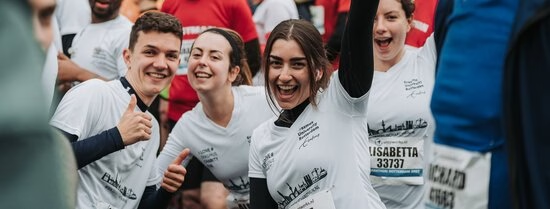
'Absolutely, yes! I’ve already started training. For me, the run is about more than sport. Scholarships open doors that simply don’t exist in some countries. They allow students to gain experiences, perspectives, and skills they could never access otherwise. I believe international classrooms, filled with different backgrounds and viewpoints, ultimately lead to better policy, better healthcare, and better outcomes for society.
By running, I hope to help ensure that future students get the same chance I did. I’m incredibly grateful, and this feels like a way to give something back.'
- More information
The Erasmus Charity Run is a sponsored run where you raise money for students who dream of studying at Erasmus University Rotterdam. You'll run alongside other participants to raise money for scholarship students.
Would you also like to help fund scholarships for talented students like Jacqui? Join the Erasmus Charity Run or donate to make dreams come true.
- Related content
- Related links
- Stichting Erasmus Trustfonds


