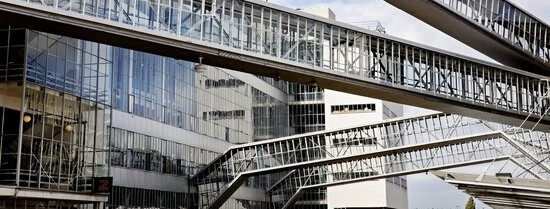
Rotterdam is known for its challenging architecture, attracting many visitors every year. Due to the 1940 bombing, Rotterdam's city centre was almost completely destroyed. In the postwar period, this ‘empty canvas’ attracted many enthusiastic architects, who started rebuilding the heart of the city. Different types of building styles were used interchangeably, making the architecture tell the story of Rotterdam.
Pre-war monuments
Not all buildings in Rotterdam were destroyed during World War II. The White House proudly remained standing. This 1898 building was Europe's very first skyscraper, with a height of 45 metres, and served as an office building for many years. The Van Nelle Factory (1925) also survived the war. This building has even been on the UNESCO World Heritage List since 2014. Moreover, the city centre is home to the Laurenskerk, the only remaining medieval building. The church is still regularly used for various events.
Nieuwe Bouwen
Even before the bombing, important architectural reforms were taking place in Rotterdam. Nieuwe Bouwen is a movement that emerged around the 1920s and is characterised by functionality, simplicity, and an absence of ornamentation. In Rotterdam at the time, this style was often combined with Bauhaus. Some well-known pre-war examples of Nieuwe Bouwen are the Van Nelle Factory, Van Tijen's Bergpolderflat (the Netherlands' first gallery flat), and the Justus van Effenblok. However, the international breakthrough of Nieuwe Bouwen did not occur until after World War II.

Seeking width and height
During reconstruction, Rotterdam was given the chance to be spacious and open. The Lijnbaan, for instance, became the Netherlands' first car-free shopping promenade. Iconic buildings from this period include the Bijenkorf and the Groothandelsgebouw. As the city grew, the demand for living and working space increased. It became inevitable, Rotterdam had to go up. This led to the port city's distinctive skyline. The Erasmus Bridge then provided a better connection to the Kop van Zuid, allowing the city to develop further on the other side of the Maas.

Eyecatchers
Rotterdam's most remarkable buildings are located around Rotterdam Blaak. For good reason, this location is mentioned in the song De Allermooiste Rotstad, also known as the Rotterdam song. The Market Hall is not only a popular place to eat but also an architectural masterpiece thanks to its unique arch shape and the houses above it. Across the street is the Central Library, a recognisable building due to its yellow tubes. Next to it is the Pencil, which also contributes to Rotterdam's eccentric character, together with the cube houses.
Future
Rotterdam continues to innovate in terms of architecture. With projects such as Luchtpark Hofbogen, an almost two kilometres long park on roofs, the renovated Coolsingel with less access for cars, and the construction of new parks and neighbourhoods in Rotterdam. Architecturally, Rotterdam will always be an inspiring, innovative, and impressive city.
- More information
This item is part of Backbone Magazine (2025). The magazine can be found in E-building or Theil-building for free. Additionally, a digital copy is available here. Backbone is the corporate magazine of Erasmus School of Economics. Since 2014, it is published once a year. The magazine highlights successful and interesting alumni, covers the latest economic trends and research, and reports on news, events, student and alumni accomplishments.
