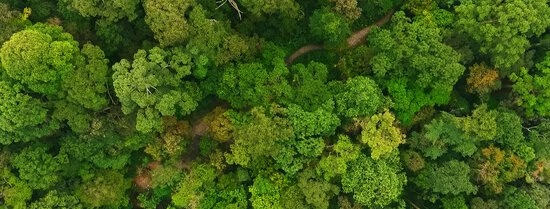
Sociologist Dr Irene van Oorschot from Erasmus University Rotterdam has received an ERC Starting Grant of €1.5 million from the European Research Council. With this prestigious grant, she will build her own research team over the next five years to investigate how the resilience of European forests against climate-related risks takes shape. EUFORESTS is the first ethnographic and comparative study of how the promising notion of resilience is implemented in practice.
European forests face significant challenges. The impacts of climate change—wildfires, insect infestations, and shifting ecological conditions—affect the economies, societies, and communities that depend on forests. To address these challenges, researchers and policymakers increasingly emphasise the importance of enhancing resilience: the capacity of forests to absorb shocks and stressors and recover afterwards.
"But how does resilience take shape in practice?" Van Oorschot wonders. "Many initiatives aimed at fostering resilience rely on animals and plants to do the work: goats and sheep grazing on fire-prone shrubs, or trees improving soil quality and forest diversity with their leaf litter. But whose idea of a 'good forest' resonates in these practices—and whose relationships with the forest are overshadowed?"
The Promise of Resilience in Contested Forests
European forests are battlegrounds of values. For states, they serve as carbon sinks; for industries, they are sources of profit. For ecologists and conservation experts, they are vital sites of biodiversity, while for rural communities, they are often sources of income and cultural identity. These differing valuations of forests frequently clash: an economically valuable monoculture may be highly flammable and typically has low ecological value.
EUFORESTS (Resilient European Forests: Unearthing, Comparing, and Conceptualizing the Values of ‘Resilience’ Across European Forest Worlds) traces how resilience takes shape within this field of conflicting values and examines which notions of "the good" prevail. Can an economically profitable forest also be resilient? How do efforts to enhance resilience intersect with the values rural or Indigenous communities assign to their forests?
The project moves beyond two opposing scientific perspectives on resilience: one that views resilience as a universal solution capable of maximising all forest values simultaneously, and another that sees a focus on resilience as inherently neoliberal and economically driven. By studying who becomes involved in initiatives to enhance resilience and whose valuations of the forest are considered, EUFORESTS provides new insights.
The research is based on ethnographic fieldwork in three strategically selected cases, each dealing with specific climate-related challenges, management traditions, and engaged publics such as shepherds, activists, and Indigenous communities: Spain, the Netherlands, and Sweden. This gives the project a much-needed inter-European comparative dimension.
In this context, Van Oorschot explicitly considers the role of non-human actors, such as various tree species, wildlife, grazers, and soil organisms. Based on this, she aims to develop a new, more-than-human theorisation of resilience that can also be applied beyond the forest by scientists seeking to understand the circulation and mobilisation of the concept of resilience.
About the ERC Starting Grants
The ERC Starting Grants support talented research leaders who are on the verge of establishing their own independent research teams. The Erasmus School of Social and Behavioural Sciences (ESSB) has been highly successful in securing ERC grants. In recent years, Dr Jess Bier, Dr Tom Emery, Prof. Dr Janna Cousijn, Prof. Dr Renske Keizer, Dr Rianne Kok, and Prof. Dr Willem Schinkel have preceded her in receiving Starting Grants. In 2012, Professor of Sociology Pearl Dykstra received an Advanced Grant. Prof.Dr Loes Keijsers & Prof. Dr Claartje ter Hoeven received a Consolidator Grant.
About Irene van Oorschot
Dr Irene van Oorschot is an assistant professor within the Public Issues and Imaginaries team at ESSB. Pragmatic philosophy, science and technology studies, and feminist and decolonial perspectives inspire her work. She is guided by the question of how climate change is known and experienced, and what uncertainties, improvisations, and anticipations it evokes in various contexts—from nature management to urban life.
Her dissertation Ways of Case-Making was awarded cum laude in 2018 and published by Cambridge University Press as the monograph The Law Multiple: Judgment and Knowledge in Practice (2021). She previously received a Marie Skłodowska-Curie Fellowship, an NWO Veni grant for her research on resilience in Dutch nature management, and a research grant from the Rotterdam-based organisation Rotterdams Weerwoord for the project Do You Feel the Change, which explored everyday experiences of climate change among Rotterdam residents. In 2027, Bloomsbury Academic will publish a volume edited by her and Dr Marguerite van den Berg titled Spells for Living in Ruins: Rehearsing Feminist Alternatives to Capitalism.
- Assistant professor
- More information
Marjolein Kooistra, communications ESSB | kooistra@essb.eur.nl | +31 683676038
