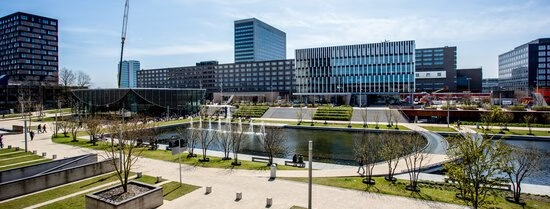
Music, educational innovation, technology and societal change: Erasmus School of Philosophy featured at several moments during the Opening of the Academic Year 2026/2027. Not as a separate part of the programme, but through students, lecturers and others connected to ESPhil.
On 31 August, Erasmus University Rotterdam officially opened the new academic year under the theme Utopia? Building resilient societies. At the heart of the event was the question of how we respond to major developments in areas such as technology, sustainability and society — themes in which philosophical questions are never far away.
Philosophy student takes the stage
One of the most visible contributions came from bachelor’s student Frits, guitarist for Lady Bits. Together with singer Bettie from Erasmus University College, he won EURvision 2026 earlier this year. The duo performed during the opening ceremony. In a larger line-up, the band had also performed at the opening of Eurekaweek.
Education Prize for Ginie Servant-Miklos
There was also a clear connection with ESPhil during the presentation of the Erasmus University Education Prize. This year’s prize went to Dr Ginie Servant-Miklos for the Bildung Climate School, which brings together students from vocational education, universities of applied sciences, research universities and arts education to work on current sustainability challenges.
Servant-Miklos is affiliated with Erasmus School of Social and Behavioural Sciences, but has worked closely with ESPhil for many years. She makes an important contribution to the master’s programme Societal Transitions and co-supervises PhD candidates together with several ESPhil colleagues.
Technology is never just technology
These questions also featured in the opening speech by President of the Executive Board Prof. Annelien Bredenoord, who is also a professor at ESPhil.
In her speech, Bredenoord warned against responding to technological developments with either simplistic optimism or doom thinking. New technology does not exist separately from the society in which it is developed and used. That is why, she argued, social innovation is needed alongside technological innovation.
This shifted the focus from what is technologically possible to an equally important question: what kind of society do we actually want to shape with that technology? It is a question in which values, choices and societal consequences take centre stage — and which therefore also has a distinctly philosophical dimension.
A familiar face as host
The ceremony was once again hosted by Nizar El Manouzi. He too has a connection with ESPhil: alongside his other studies at Erasmus University, he is enrolled in the bachelor’s programme Philosophy of a Specific Discipline.
Philosophy was therefore present in a variety of ways throughout the opening: in the music, in award-winning education and in the themes discussed. A fitting start to a new academic year in which many of the questions raised during the ceremony — about technology, sustainability and societal change — are also very much at the heart of ESPhil.
