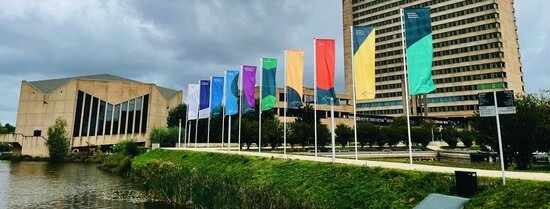
On Tuesday 1 December, the Econometrics Group of Energy Optimization (EGEO) organizes a workshop on energy optimization. EGEO consists of researchers at the Econometrics Institute at the Erasmus School of Economics. The group is part of the Erasmus Center for Energy Transition (ECET). Three scientists of EGEO will give a talk on their research. The intended audience are practitioners and academics involved in the energy transition.
- Date
- Tuesday 1 Dec 2026, 14:00 - 17:00
- Type
- Workshop
- Room
- C2-6
- Building
- Theil Building
- Location
- Campus Woudestein
Programme
Introduction by EGEO and ECET.

Affiliation
Econometric Institute, Erasmus School of Economics, Erasmus University Rotterdam
Abstract
Energy systems are growing more complex, and decisions in markets, assets, and grids increasingly depend on capturing that complexity correctly. This talk shows what mathematical modeling can offer practitioners through three real-world cases. A policy decision: how a simple cross-border trading rule can push the grid to its limits, raising hidden blackout risks, and how math reveals its true impact to inform better policy. An operational decision: how a more realistic model of hydrogen production gives asset owners actionable schedules that increase net profit by up to 30% compared with the models commonly used today. A market design decision: how grid operators can design local congestion tariffs that steer energy hubs and flexibility providers to reduce grid congestion by 96%.

Affiliation
Econometric Institute, Erasmus School of Economics, Erasmus University Rotterdam
Abstract
Electricity grid operators control how much power can be traded between countries, but their national interests may conflict with those of the wider European market. Historically, this has led to conflicts between transmission system operators (e.g., those of Norway and Sweden). We look at this issue from a theoretical economic perspective and show that operators can often benefit their own country by temporarily reducing cross-border transmission capacity, while hurting the international system as a whole. Using Denmark as a case study, we also examine whether European regulation can limit these incentives.

Affiliation
Econometric Institute, Erasmus School of Economics, Erasmus University Rotterdam
Abstract
The electrification of transport brings a growing share of energy demand into the home, and an increasing number of Dutch households now have dynamic electricity contracts that reward charging when electricity is cheap. For a household, deciding when and how much to charge is less simple than it seems: tomorrow's driving needs are uncertain, running short may require an expensive stop at a public charger, and limited charging power can force charging into more expensive hours. In this talk, I will discuss how these trade-offs shape the charging decision and which simple decision rules follow from it. Using Dutch day-ahead electricity prices, I will then compare common charging habits and simple rules with the optimal charging policy, showing when simple approaches work well, when they fall short, and which information is most valuable for better decisions. Finally, I will discuss what these findings imply for the design of smart-charging services and for the practical value of dynamic electricity contracts.
Registration
If you wish to attend this workshop please register below. Registration is free.
Registration deadline: Sunday, 22 November 2026.
Organiser

- More information
If you have any questions about this workshop, please contact Remy Spliet.
