The transport sector, like many others, is experiencing a significant transformation known as the mobility transition. This transition involves reducing societal dependence on fossil fuels and encouraging the adoption of alternative forms of transportation.
In urban areas, this means decreasing reliance on cars and promoting active travel methods such as cycling and walking, along with other forms of mobility. Among these alternative transportation methods, shared electric bikes, mopeds, and scooters have seen rapid development in recent years. These modes of transport are commonly referred to as floating mobility, micro-mobility, or shared mobility services.
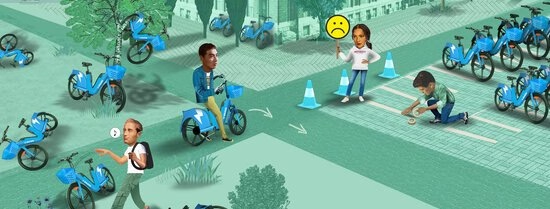
Although there is no scientific proof yet that micro-mobility reduces congestion and emissions in cities, these services have rapidly become part of the urban landscape. Despite their popularity, shared mobility services also pose challenges, with parking being the most significant (and visible) issue. Images of poorly parked or fallen bikes, scooters, and mopeds are common in many cities. This issue affects both aesthetics and safety and, more in general, the quality of life in urban areas. Local authorities currently have limited enforcement power over shared mobility services. These services are relatively new, and legislation has not yet addressed them. Therefore, fallen scooters or improperly parked bikes on curbs or green areas may be unsightly, but are not illegal.
Micro-mobility providers have tried to address the parking issue. They have implemented both negative (fines or account disabling) and positive incentives (extra credit for correct parking), but neither has been effective. Moreover, they are hesitant to strictly enforce penalties to avoid alienating customers.
The behavioural approach
How can we encourage proper parking of shared vehicles without law enforcement or fines? Behavioural economics can help. Combining psychology, neuroscience, economics, and sociology, it aims to better understand human behaviour.
Since 2017, Erasmus School of Economics has offered a master's course in Behavioural Transport Economics. In this course, unique in Europe, students learn to apply behavioural techniques to solve transportation-related societal issues and conduct real-life experiments. In recent academic years, we addressed the issue of chaotically parked shared e-mopeds within our campus. Armed with a lot of creativity, some posters, and duct tape, students have applied some of the basic principles of behavioural economics – mainly social norms and framing – to nudge visitors to park the e-mopeds in a correct way.
How do you do it? Each experiment involves taking before-and-after measurements and using nudging techniques. Students must collect data on the number of incorrectly parked shared e-mopeds before and after their intervention to assess its impact. Students typically use two nudging techniques. The first involves posters promoting good behaviour (e.g., parking e-mopeds properly) or discouraging bad behaviour (e.g., improper parking). Posters can test various messages, colours, and images. The second technique uses duct tape to mark parking spots, guiding users to park correctly.
‘The effects are visible even beyond the boundaries of our campus: that’s what we call creating positive societal impact!’
Implementation of the results
The experiments were very successful, leading the university to design permanent parking spots for e-mopeds at various locations within the campus.
Of course, not all issues can be resolved with a simple line or poster. For instance, when the number of e-mopeds exceeds the total parking capacity, individuals may still park them improperly. Additionally, behavioural principles can sometimes have adverse effects. If the first user in the morning parks the e-moped incorrectly (e.g., diagonally occupying two parking spots instead of one), subsequent users may follow suit, thereby establishing a social norm.
Yet, behavioural science has effectively reduced the nuisance of shared mobility services on campus with minimal investment. And the effects are visible even beyond the boundaries of our campus. In the last two years, the municipality of Rotterdam has implemented this approach in several areas, naming them mobility hubs. Other Dutch cities are following suit. That’s what we call creating positive societal impact!

About Giuliano Mingardo
Giuliano Mingardo is senior researcher in Urban and Transport Economics at Erasmus Centre for Urban, Port and Transport Economics. His research interests lie within the field of urban mobility, parking policy and management and shared mobility services and mobility hubs.
- Researcher
- More information
This item is part of Backbone Magazine 2025. The magazine can be found in E-building or Theil-building for free. Additionally, a digital copy is available here. Backbone is the corporate magazine of Erasmus School of Economics. Since 2014, it is published once a year. The magazine highlights successful and interesting alumni, covers the latest economic trends and research, and reports on news, events, student and alumni accomplishments.
