When Georgios Chomatas talks about history, he doesn’t sound like someone who spends his days buried in archives. He sounds like someone trying to understand the present, and change it. 'I loved stories from a very young age', he says. 'Mythology at first, and later more serious stories. But quite early on, I realised this: if we want to understand ourselves, we have to understand our history.'
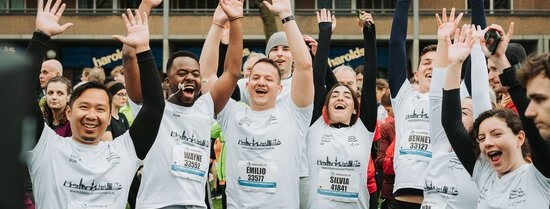
Georgios grew up on Crete, and later moved to Thessaloniki, where he studied history and archaeology in his search for the most fundamental story of all. With the help of an Erasmus Trustfonds scholarship he is now doing the MA Applied History at Erasmus School of History, Culture and Communication at Erasmus University Rotterdam. To help other students looking for the same opportunity, he will be participating in the Erasmus Charity Run.
What was your first impression of studying in the Netherlands?
'Three years ago, I visited a friend here. I really liked the functionality of the country, the way things are organized and the way the educational system works. Everything felt… purposeful. While researching master’s programs, I stumbled upon something that definitely caught my interest: the MA Applied History at Erasmus University.
At first, I couldn’t really fathom what it was. Even up until September, when I actually started the program, I don’t think I fully understood its essence. But now I am seven months in, and I am genuinely stoked about the course. It’s a very contemporary way of looking at history. We’re taught how to use historical insight and critical thinking to solve modern problems. It’s interdisciplinary, using economics, politics and sociology. It’s not about the past as something distant or detached. It’s about the past as a tool.
Adjusting to life in the Netherlands wasn’t difficult. The rhythm of daily life suits me. The academic pace, however, was a bit of a shock. In Greece, semesters are six months long. Here, you have four short terms. Everything moves fast!'
How can we use history to change the present?
'People say history repeats itself. I don’t think that’s entirely true. I think history rhymes, like poetry. Patterns reappear, not as copies, but as echoes. Trade wars, political tensions, social movements, they may look familiar, but they are never exactly identical.

Yet, we can learn from how people dealt with similar problems before. Not to copy them, but to understand the consequences of certain choices. Applied History also teaches something more fundamental. It teaches us to be humane. Only by helping each other, by working in unison, can the world become a better place.'
What does the Erasmus Trustfonds scholarship mean for you?
'When the acceptance email for the course arrived, I was at work. I couldn’t believe it! I had three other people read the email, just to make sure I wasn’t imagining things. The scholarship confirmation came months later. That was otherworldly. I thought: this is a sign. This is meant to be. Without the scholarship, I would still have come to Rotterdam, but under far greater financial pressure. Now, I can really focus on my studies. That makes a huge difference.
But the importance of scholarships goes far beyond individual opportunity. When I met the other scholarship students, I realised how vast this ocean of knowledge is. And there are so many more people who could contribute so much to society, but never get the chance. It doesn’t just affect one person. Or even one country. You meet eight people, those eight people affect others, and it becomes a chain reaction. International cooperation is becoming more and more important, as we’re not that distant from each other anymore. I think it is important to start this cooperation as early as possible, preferably during student life. This openness is part of what makes the Netherlands innovative. It gives young people the chance to study what they truly care about. And in return, students give back their work, their ideas, their knowledge. It’s a relationship that goes both ways.'

And now you will be running for those who come next?
'Exactly. I love running, and this will be my first ¼ marathon. But more than a physical challenge, the Erasmus Charity Run is a way to give visibility to the scholarship, and to help create opportunities for future students. It’s such a beautiful way to raise awareness and funds; my friends, family, and peers have already contributed. They really like the idea that society can help people study what they want to study. To gain knowledge. To grow.
History may rhyme, but the future, I believe, is still being written. And sometimes, it begins with putting one foot in front of the other.'
- More information
The Erasmus Charity Run is a sponsored run where you raise money for students who dream of studying at Erasmus University Rotterdam. You'll run alongside other participants to raise money for scholarship students.
Would you also like to help fund scholarships for talented students like Georgios? Join the Erasmus Charity Run or donate to make dreams come true.
- Related content
- Related links
- Stichting Erasmus Trustfonds


