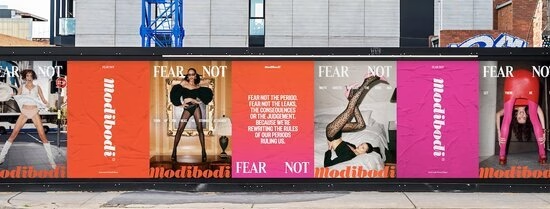
Menstruation is often surrounded by silence and shame, but social business has helped change that. In her research, Maria Carmen Punzi shows how social enterprises use products, branding and communication to challenge stigma and influence how people understand their bodies and health. 'Business does play a role,' she says. 'It’s not a neutral category.'
In 2015, while studying abroad, Maria Carmen Punzi read an article that would quietly redirect her life and career. It described a practice in western Nepal where menstruating women are banished from their homes and forced to sleep outside, sometimes in sheds with livestock. 'If you’re menstruating, you’re considered impure,' she recalls. 'You have to isolate yourself. You cannot cook, you cannot sleep in your own bed'.
What struck her most was not only the severity of the practice, but the framing. 'I remember thinking: this is a matter of gender equality,' she says. And yet, menstruation was rarely discussed in those terms. That realisation marked the beginning of a parallel journey: learning more about menstrual health academically, while also rethinking her own relationship with her body. 'The personal and the professional really connected,' she reflects. 'That’s a red thread in my life' (See also her Instagram @periodswithmariacarmen)
Learning to hide (a vital sign)
Punzi’s research shows that extreme practices like menstrual exile are part of a much broader pattern of social censorship. In many countries, menstruation is something girls learn to hide from a very young age. Growing up in Italy, she remembers classmates whispering in school corridors, checking each other for blood stains. 'There’s such an embarrassment about the idea of not being able to manage menstruation that the most important thing is to conceal it,' she says. Even within families, silence prevails. 'I learned to hide it from my own brothers, even though I was never explicitly told to', she adds.
This concealment comes with consequences. Menstruation is often framed as dirty, disruptive or something that makes women unpredictable. 'It’s interesting,' the researcher notes, 'because menstruation is actually a vital sign, like heart rate or temperature'. Ignoring it means missing early signals of health problems. Yet culturally, it is dismissed as something to endure quietly.
The role of brands
A central insight of Punzi’s PhD research is that businesses have played a powerful role in reinforcing this stigma. For decades, mainstream menstrual product marketing revolved around invisibility. 'The promise was: we can help you hide that you’re menstruating,' she says. 'If you wear our product, you can be bleeding in white pants while doing cartwheels in a flower field. Anyone who has ever had a period knows that’s not realistic.'

But markets are not static. In the early 2000s, small social enterprises began to challenge this narrative. They introduced reusable products, organic materials and radically different messaging. 'They tried to take menstruation out of the taboo sphere,' Punzi explains, 'teaching women to understand their own bodies and to care about ingredients' Initially, these brands were niche, expensive and sometimes dismissed as "hippie" alternatives. But over time, something shifted. Social conversations about hormones, fertility and menstrual health grew louder, and the social enterprises gained momentum. 'Social change and market change have gone together,' Punzi says. 'Business does play a role and it is not neutral.'
When pioneers reshape the mainstream
Her research shows that pioneering social enterprises helped pave the way for change. Today, reusable products and organic options are widely available, including from large multinational brands. Advertising has changed too. "No more blue liquid," Punzi notes. 'Now everyone uses red liquid to represent menstrual blood. There’s much more of an empowerment narrative.' She points, for example, to Yoni, a Dutch social enterprise that introduced organic cotton products and explicit, body-positive messaging long before such language became mainstream.
Yet imitation is not the same as transformation. Big corporations followed the change in customer preferences and social expectations, often adopting the language of sustainability without fully embracing its substance. 'Sometimes you realise it’s only the top layer of the widely available commercial products that’s organic, even though these companies are being loud and proud about their sustainable choices,' she says. 'There’s a bit of greenwashing, or perhaps redwashing'. Still, the impact of the pioneer social enterprises on society and the market alike is undeniable. 'They moved the needle,' the researcher argues. 'They influenced how individuals, other companies and society think, talk and act around menstruation.'

'Menstrual health is a structural condition for gender equality'
Maria Carmen Punzi
PhD Candidate in Business-Society Management.
Chemicals are not for pussies
Humour played a crucial role in opening that conversation. Some social enterprises deliberately use playful or provocative campaigns to make menstruation visible without pointing fingers. Punzi points to examples where brands used irony, memes or slogans like "chemicals are not for pussies" to disarm discomfort and invite discussion, rather than shame or silence.
When scandals or controversies around social enterprises occur, customer reactions are far more intense than they would be toward large corporations. 'People feel heartbroken,' she recalls. 'They say: "I trusted this brand'. She points, for example, to a US-based period underwear company where testing revealed the presence of harmful chemicals. Customers were not just angry, but personally disappointed, because they had actively promoted the brand to friends and felt emotionally invested in its mission.
Not all social enterprises survive. Over time, Punzi identifies three main trajectories. Some close their doors, declaring their mission accomplished. 'The taboo is mostly broken,' they say, "the market looks different". Others professionalise or expand into related areas such as menopause, sexual health or fertility. And some are acquired by larger competitors. Together, these paths tell a broader story. Menstrual products are not just products and the companies behind them are not just neutral actors. They shape how people relate to their bodies and what people perceive as normal. As Punzi puts it: 'menstrual health is a structural condition for gender equality.'
- PhD student
- More information
On 23 January, Maria Carmen Punzi will defend her PhD thesis 'The Business of Breaking Taboos: Social Entrepreneurs as Catalysts for Change in Menstrual Health'
Discover more about her research via Instagram
Press enquiries? Please contact Danielle Baan by telephone on +31 (0)10 408 2028 or by email at baan@rsm.nl.
- Related content


