
Is this the programme you're looking for?
Do you want to investigate how contemporary societal challenges such as (postcolonial) migration, inequality, and climate change are shaped by the past? And would you like to do so by applying approaches that more directly prepare you for the labour market in a hands-on manner? Then the master specialisation Applied History is the right programme for you.
Practical information
- Type
- Master
- Degree
- MA
- Mode of study
- Full-time | Part-time
- Instruction language
- English
- Duration
- 1 year
- Study points (EC)
- 60
- Location
- Campus Woudestein
- Start date
- September
- Application Deadline (EEA)
- 15 May
The study programme in a nutshell
During the master specialisation Applied History, you will learn to analyse and address contemporary societal challenges from a long-term historical perspective. You will do so in a practical, hands-on manner, to directly prepare you for the job market. You will analyse events from a cultural, economic, political, and social perspective and learn essential skills to gather and present your research results in a professional manner. As part of your programme, you will have the opportunity to take a longer internship in comparison to other programmes, to build up your work experience. In addition, next to conducting academic research for your thesis, you will be able to translate your research into an applied final project, such as a plan for an exhibition, a podcast, a documentary, or a policy paper.
''You can really make it your own so if you're interested in history this is really the study for you.''

What you will learn
- Learn why it is important to analyse contemporary societal challenges, such as (postcolonial) migration, inequality, and climate change, from a long-term historical perspective;
- Learn how communities, industries, and societies engage with their pasts today, and how we can use historical insight to formulate evidence-based policy advice for the present;
- Learn how we can use historical methods such as oral history and digital humanities to address contemporary societal challenges;
- Take a longer internship in comparison to other programmes to build up work experience and directly apply what you have learned in the field;
- Communicate your research findings in diverse formats, such as an exhibition, a podcast, a documentary, or a policy paper, alongside classical academic research papers.
Is this the right programme for you?
Applied History is the programme for you if you are looking for a practice-oriented Master’s specialisation. You are interested in the insights offered by modern history (from around 1500 onwards) and how to use those insights to tackle contemporary challenges through research, consultancy, policy, education and practical applications.
Want to know more? Meet us here

Career opportunities after graduation
The master specialisation Applied History will jumpstart your career as a historian or researcher. But you can also work as a policymaker, manager or researcher at cultural institutions, government authorities, consultancies, archives or in the media.
What do our students think?

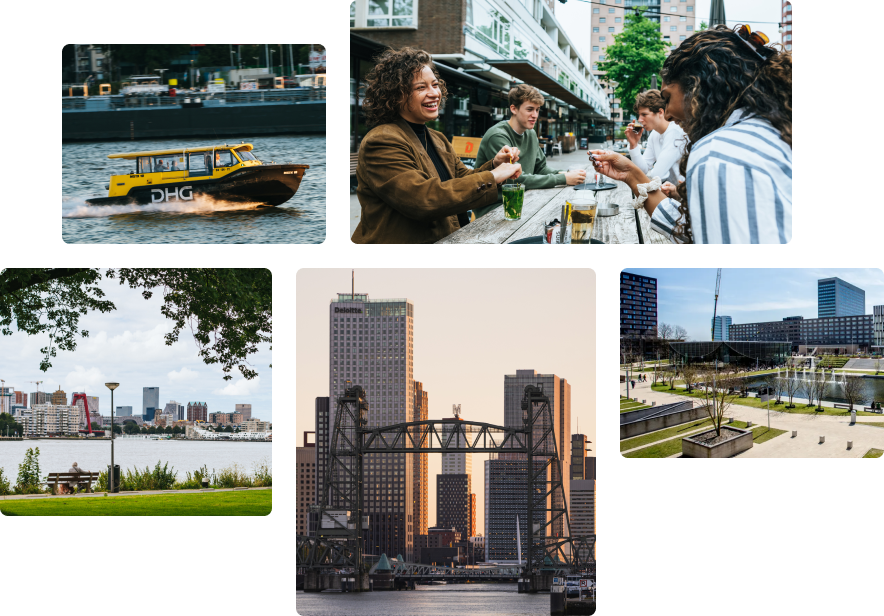
Your student life starts in the vibrant city of Rotterdam
This vibrant city offers a variety in art, nightlife, culture and sports. Everything you wish for to enjoy your student life to the fullest.
Not sure yet about your choice? Request a brochure!
Choosing a study is quite a challenge! Still in doubt about this study and want to have a good overview? Receive a clear digital brochure for this study.