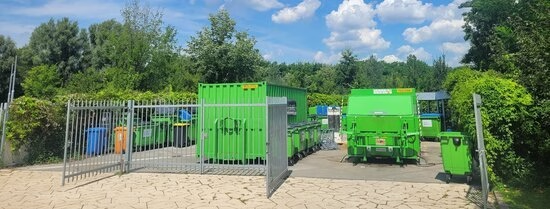
Every day, EUR's campuses generate waste and consume water. How we manage these resources is a practical reflection of our commitment to circularity. EUR is working to close the loop: reducing waste, keeping materials and resources in use for longer, and using water more deliberately across campus.
Our ambition
EUR aims to become a fully circular university, guided by a broader principle of responsible resource use: consuming only what's needed, and keeping materials, water, and energy in productive use for as long as possible. A major milestone is to achieve zero waste by 2030, alongside a target to halve the use of primary raw materials by the same year. This means reducing the waste we produce, improving how waste is separated and, wherever possible, keeping materials in circulation rather than treating them as disposable — from a chair to a building.
Where we stand (2025 data)
| Waste volume vs. 2024 | Waste per person vs. 2024* | Waste-related emissions | Recycled or recovered** | Drinking water use*** |
|---|---|---|---|---|
| -27.4% | -24% | -47.3% | -100% | 82,113 m3 |
*10.32kg per student & employee. **Only bulk waste was sent to landfill. ***Stable since 2018. | ||||

Waste separation & partnership
Waste separation has been part of campus operations since 2020, with dedicated bins for organic waste, coffee cups, paper, plastics, and residual waste. Additional waste streams — including small chemical waste, glass, swill, white goods, and construction waste — are managed through dedicated procedures. Composting machines help process food waste on-site, reducing the amount of waste sent off campus.
In 2025, Seenons became EUR's waste management partner, supporting a more circular and transparent approach to waste across campus. Seenons provides comprehensive data on the types and volume of waste EUR generates. As a result, waste-related emissions data now looks meaningfully different from previous years, reflecting improved measurement and reporting.

Reducing litter and single-use waste
A 2024 pilot with cleaning partner GOM tested interventions to reduce litter on campus. It built on earlier work with BIG'R, which achieved a 63% reduction in litter using behavioural science insights.
Disposable cups were removed from Vitam coffee corners and hot drink machines across Woudestein, EUC, and ISS in January 2024. EUR has continued to develop its reusable cup approach since then. In 2025, EUR launched an ongoing pilot in partnership with Maas, introducing reusable cup machines at the University Library, Sanders Building and Theil Buidling.
Reusable cups are also available for purchase through Vitam and the University Library. As a fallback, a pulp-based, plastic-free disposable cup is available for a small additional cost.

Circular construction & demolition
Circularity is embedded in how EUR builds, renovates, and demolishes its buildings. The construction of the Langeveld Building reused materials from other EUR and external projects, contributing to its BREEAM 'Outstanding' score of 91.5% and a Circularity Performance Building score of 9. The renovation of the Tinbergen Building, launched in May 2025, goes a step further. Valuable materials are being recovered from the building for reuse through a circular stripping process, in collabroation with specialist partner Alba Concepts. The construction also uses low-carbon aluminium (producing roughly 4kg of CO2 per kilo, versus 15.1kg for conventional aluminium), low-carbon steel, and partly recycled gypsum. One curious example of reuse: some of the metal interior walls now being reused in Tinbergen Building previously served at the NATO summit in June 2025.
Circularity extends to how buildings come down, too. Five outdated, energy-inefficient buildings (F, G, N, Q, and V) were closed in 2025 ahead of planned demolition in 2027. Lighting fixtures, fire extinguishers, Wi-Fi access points, and electronic locking systems are being reused elsewhere on campus. For the demolition itself, EUR is developing material passports for these buildings: a digital record of the materials each building contains, including their condition and quantities, This makes it possible to identify and recover as much as possible for reuse elsewhere, rather than treating these materials as waste.
Circular procurement
Circularity is also built into how EUR buys. By 2026, all tenders will apply the R-ladder, a framework prioritising reduction, reuse, and recycling - in that order. See Sustainable procurement for more detail on how the R-ladder is applied across tenders.

Water
EUR manages water through a mix of efficiency measures and pilot projects, although a formal water reduction target is not yet in place. Low-flow fixtures have been installed in selected buildings, and reusable cup systems help reduce the water footprint tied to single-use items. EUR's Green Campus approach also promotes nature-based solutions and climate adaptation that contribute to improved water management, including green roofs that help retain rainwater. As a pilot, rooftop rainwater is collected to irrigate the indoor plants in Langeveld Building. This is one of several living-lab-style projects testing rainwater harvesting and green roofing as scalable solutions, developed with interdisciplinary input from academic departments working on urban sustainability and climate resilience.
EUR provides water taps across campus where students and staff can easily fill their own bottles to encourage drinking tap water over bottled water. Indoor taps are available in the Polak Building, University Library, Sanders Building, and Langeveld Building. Outdoors, a Join the Pipe water tap stands in front of SPAR University, alongside three KRNWTR+ taps: at the intersection of Institutes Avenue and Collegelaan (near the tennis courts), in front of the Erasmus Building near the pond, and at the entrance to the campus garden, near the bee hives.