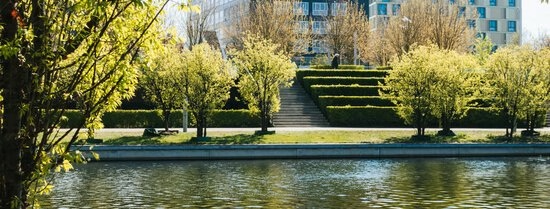
Since 2011, EUR has been redeveloping the Woudestein campus under the Tomorrow's Campus initiative — creating a sustainable, healthy, and inclusive campus environment through sustainable construction, renovation, circular demolition, and energy transition measures.
Our ambition
In line with our Climate and Ecological Emergency Declaration, we're working towards net-zero emissions across our buildings: scope 1 & 2 by 2030, and scope 3 by 2035. Our Portfolio Roadmap Energy Transition (2022-2050) sets out how each university property will be adapted over time to meet these targets.
Where we stand (2025 data)
| Scope 1 & 2 emissions vs. 2024* | Capital goods emissions vs. 2024** | Renewable electricity | Solar-generated electricity*** |
|---|---|---|---|
| +57% | +12% | 100% | 419.58MWh |
*This increase is not the result of higher energy consumption but reflects the revision of emission factors by the RVO in the Co2emissiefactoren database: the emission factor for district heating increased from 25.05 to 38.43 kg CO2 e /GJ, a steep increase reflecting the latest developments in Dutch district heating infrastructure and generation. ***Across 9 campus buildings — rooftop capacity now fully used, remaining roofs support green roofs. | |||

Dutch wind energy
EUR purchases Dutch Guarantees of Origin for wind-generated electricity, meaning 100% of the electricity we buy is renewable and produced in the Netherlands. In 2025, EUR used 15,080.09 MWh of electricity in total: 97.22% or 14,660.41 MWh purchased (backed by Dutch wind Guarantees of Origin) and 2.77% or 419.68 MWh self-generated on campus.

Solar energy
EUR generates its own electricity through solar panels installed across campus rooftops, currently on 9 buildings. This is the maximum rooftop capacity available: most of the remaining roof space is already in use for green roofs, which support biodiversity and rainwater management instead. Self-generated solar electricity has grown from 358,613 kWh in 2023 to 419,680 kWh in 2025.

Heat and cold storage (ATES)
ATES (Aquifer Thermal Energy Storage) stores energy as heat or cold underground, allowing buildings to be sustainably heated and cooled using the stored temperature difference rather than fossil fuels. Several buildings are already connected to the campus ATES system, with further buildings, including Tinbergen, planned to follow as their renovations progress. Where buildings aren't yet connected to ATES, regular heat is supplied through the district heating network.

BREEAM certification
BREEAM is the world's leading sustainability assessment method for buildings, and the current standard EUR uses to assess new construction and renovation. An 'Outstanding' rating, which is the highest tier, is achieved by fewer than 1% of buildings in the Netherlands. EUR is also investigating whether existing buildings can be certified under BREEAM-in-Use, and whether future building demolition can follow the BREEAM-NL Demolition and Dismantling standard.

Langeveld Building
Opened in November 2022 and named after Henny Langeveld, EUR's first female professor, the Langeveld Building is one of the most sustainable educational buildings in the Netherlands, achieving a BREEAM 'Outstanding' rating of 91.5%. The building is energy-positive: it generates more power than it uses, through roof-mounted solar panels, heat pumps, and underground heat and cold storage. Its ventilation system is a world first, inspired by the natural ventilation of termite mounds and developed from TU Delft research, and it uses up to 85% less energy than conventional systems. The building was constructed using circular principles, with reused and biobased materials tracked through a digital material passport, and is used daily by around 3,000 students.

Tinbergen Building renovation
EUR's largest building, Tinbergen, is undergoing a large-scale sustainable renovation that began in 2024. The renovation has been awarded a BREEAM 'Outstanding' design certificate, and in 2025 was ranked among the top 10% most sustainable building renovations in the Netherlands. Once complete, Tinbergen will also be connected to the campus ATES system.

Energy-neutral Sports Building
Opened in September 2022, the Sports Building is fully energy-neutral, powered by rooftop solar panels and connected to the campus's thermal energy storage system. It was partly built using circular construction principles, including reused wooden wall panels sourced from a former sports hall elsewhere in the Netherlands.
Circular construction & demolition
Circular building practices run through several of the projects above, from Langeveld's material passport to the Sports Building's reused floor panels. This extends to how EUR removes buildings, not just how it builds them: several outdated, energy-inefficient buildings are being closed and dismantled circularly in the coming years to make more efficient use of campus space. More on circular practices across campus is covered in Waste, Circularity & Resource Use.
Responsible use of carbon offsetting
EUR is developing a net-zero strategy to guide its emission-reduction approach, including how it handles unavoidable emissions. Any abatement strategies, including carbon credits, will only be used as a last resort, after emissions have first been reduced at the source, and will follow the Oxford Principles for net-zero aligned offsetting.