The University Library of Erasmus University Rotterdam (EUR) has had a rich history in knowledge sharing and service provision since its establishment in 1914. What began as the library of the Nederlandsche Handels-Hogeschool (Netherlands School of Commerce, better known as NHH) has evolved into a modern university library offering a wide range of academic and cultural services.

The early years: NHH Library (1914-1938)
The NHH library opened its doors in 1914 in Rotterdam, located in the building of the Rotterdamsch Leeskabinet at the Geldersekade. The collection at the time consisted of approximately 5,000 books and journals, primarily focused on trade and economics. In 1916, the library moved to Pieter de Hoochweg. With its extensive opening hours and the availability of the reading and study room, as well as lending services for students, faculty members, and the general public, the library was highly accessible. This is evident from the high number of visitors: 18,500 during the academic year 1917–1918.

War years and name change (1939-1946)
In 1939, the NHH was renamed the Nederlandsche Economische Hogeschool (Netherlands School of Economics, better known as NEH). The subsequent war years brought significant turmoil: in 1943, the building was requisitioned by the German occupiers. Thanks to temporary locations on the Coolsingel and later the Hoflaan, the library was able to continue its operations. In 1946, the library returned to its original location.
Reconstruction and growth (1950-1960)
Thanks to financial support from the Marshall Plan, the collection grew to over 100,000 books during the 1950s. The increasing demand for academic resources, driven by the establishment of new faculties, necessitated new housing. In 1968, the NEH and the library moved to the newly built Woudestein campus on Burgemeester Oudlaan. A few years later, in 1973, the Medical Faculty Rotterdam and the NEH merged to form Erasmus University Rotterdam. The library was then given its current name: University Library Erasmus University Rotterdam.


Technological advancements and expansion (1970-2000)
From the 1970s and 1980s onward, the Library strongly focused on automation. A significant step was the introduction of the Randtriever, an automated storage and retrieve system for books. In 1984, the lending system was linked to the Randtriever, and in 1986, the online public catalogue (OPC) was introduced. As early as 1979, the Library became a member of the Pica Consortium, the organization for library automation in the Netherlands, which ensured that collection titles were centrally catalogued and made digitally available.


In 1986/87, the University Library was expanded on the east side. The stacks and the study areas on the floors above were enlarged to accommodate the growing collection and provide more study spaces.

From 1990 onwards, users could activate the Randtriever themselves by searching for a book in the OPC and requesting it via the public terminals. Within half an hour, the book was ready for pickup! To improve handling the increased volume of requests and book checkouts, new, large information and circulation desks were built in 1994. The library's services also evolved. In the late 1990s, the University Library began processing requests via email. This was later developed into the 'Virtual Desk' with a specialised request-processing system.


Collaboration with the Rotterdamsch Leeskabinet (1971)
Founded in 1859, the Rotterdamsch Leeskabinet (RLK) was incorporated into the Library in 1971. This collaboration made it possible to provide access to both academic and general literature for a broad audience. RLK offers an extensive collection of books and journals for literary enjoyment and scientific, cultural, and societal enrichment. RLK also organises lectures and other activities in the fields of literature, culture, and science, establishing it as an important cultural and literary centre for Rotterdam.


Changes in the 2000s
With the rise of online databases and e-books, the Library shifted its focus from physical books to digital resources. As a result, the number of loans from the printed collection steadily declined. Physical bookshelves made way for study spaces, and the reading rooms were redesigned to better meet users' needs. Over the years, the once quiet, formal building transformed into a meeting place and study hub. In 2006, the Erasmus Data Service Centre (EDSC) was set up to provide access to financial databases and offer students and researchers individual guidance and workshops.


Renovation (2015-2017)
In 2015, the Library was renovated to create a modern, flexible space for study and collaboration. The new design won the Public Award at the 2017 Rotterdam Architecture Prize. The renovated building now offers over 950 study spaces and 50 office workstations, focusing on digital access to support researchers, lecturers, and students in their academic work. A striking feature of the building's design is the niche in the centre of the space containing wooden shelves which showcase part of the open collection of the Rotterdamsch Leeskabinet.


Collections
The University Library manages more than 900,000 printed publications, over 120,000 e-journals, 1 million e-books, as well as several significant heritage collections. These include, among others, the library of Nobel Prize winner Jan Tinbergen and early printed works dating back to before 1850. The Library also collaborates with the Stichting Universitair Historisch Kabinet (SUHK) to oversee the university's academic heritage, including photographs, objects and documents that collectively tell the story of its history. The Library also supports researchers with specialised collections such as the History Didactics Collection and the Patient Experience Stories Collection. Through these broad and diverse collections, the Library contributes to the preservation of knowledge and scientific research at Erasmus University Rotterdam.


Present and future
Today, the University Library remains true to its original mission of making knowledge accessible. Although digitalisation has profoundly changed the way students, lecturers and researchers work, customer focus and high-quality service remain at the core of our operations. As we continue to evolve, supporting the academic community and promoting knowledge sharing in an increasingly digital world remains paramount.
- Reading room of NHH Library.
- Stacks of books at the temporary library location at the Hoflaan.
- Construction of the library, 1967–1968.
- Aerial view of the library under construction on the Woudestein campus, 1967–1968.
- Moving to the new library building with no less than 6 kilometers of books, 1967–1968.
- Interior design of the new library building, 1967/1968. The ceramic wall decoration along the balustrade is also clearly visible here. It depicts the genesis of the letter character and its significance in human communication. The ceramic wall decoration - 62 metres long and 1.30 metres high—was created in collaboration with the pottery factory “De Porceleyne Fles” in Delft.
- The Randtriever automated book storage system (1969–2014).
- Randtriever in use at the circulation desk.
- A student consults the catalogue on a public terminal.
- Expansion of the library building on the east side, 1986–1987.
- Searching for and requesting books in the OPC (online public catalogue) in the 1990s.
- Working at the Virtual Desk and processing interlibrary loan (ILL) requests, 2012.
- Librarian Jaap de Jongh and a colleague cataloging books at the Rotterdamsch Leeskabinet, 1979.
- Reading table at the Rotterdamsch Leeskabinet, 2007.
- A lecture by Frits van Oostrom, organised by the Leeskabinet, 2006
- Renovation of the reading room in the former open periodicals stacks, 2009.
- The original information desk and circulation desk were installed in 1994. During the library’s redesign in 2007, the information desk was removed and a new desk was placed at the head of the circulation desk. Workstations with computers were set up where the old information desk had been.
- The reading room was redesigned with study blocks, with the study spaces separated by brightly coloured partitions.
- Paul Plaatsman leads a workshop organised by the Erasmus Data Service Centre (EDSC), 2009.
- A section with terminals for consulting the catalogue, 2000s.
- The V Building, the temporary home of the Library and the Rotterdamsch Leeskabinet during the renovation of the library building, 2015–2017.
- The entrance to the Library after the 2017 renovation. The tiled wall is a work of art by Marijn van Kreij. The tiles were hand-painted by EUR staff and students and each features the same image fragment (a detail from Picasso’s 1956 painting “The Studio”). The work emphasizes a place to isolate yourself - for concentration and study - from where you can then refocus on the world.
- Niche displaying part of the Rotterdamsch Leeskabinet collection, 2023.
- Display case featuring the Nobel Prize in Economics, awarded in 1969 in Stockholm to Jan Tinbergen. On view in the Erasmus Building.
- Book from the library’s heritage collections. “Groot A, B, C, boek, zeer bequaem voor de ionge kinderen om te leeren. Men moet in den A, B, C, geoeffent wesen” by Coenraat Vatman, 18th century.
- The oldest medal from the collection of the Nederlands Economisch PenningKabinet (NEPK) features a portrait of Desiderius Erasmus, the namesake of Erasmus University Rotterdam, circa 1531.
- The gold crown pen used by Queen Wilhelmina at the opening of the building of the Nederlandsche Handels-Hoogeschool on November 8, 1916, and by Queen Juliana at the opening of the new building of the Nederlandse Economische Hogeschool Woudestein on May 19, 1970. The names of both queens, as well as the dates of both openings, are engraved on the pen.
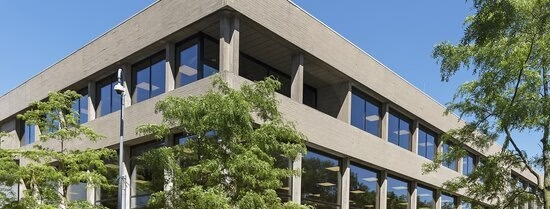
- Exterior of the University Library building, 2023

Want to see more?


The EUR in focus: digitized heritage
View historical photos of the NHH and other heritage collections at Erasmus University
