The University Library of Erasmus University Rotterdam manages the unique heritage collections of the economist and Nobel Prize winner, Jan Tinbergen. This page provides information on Jan Tinbergen's life and work, the contents of his private academic library and work archive, and how to access these materials.

Who was Jan Tinbergen?
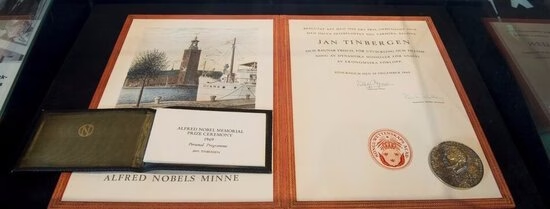
In 1969, Jan Tinbergen (1903‑1994) became the first - and, to date, the only - researcher from Erasmus University Rotterdam to receive a Nobel Prize for his contributions to economic science. He was affiliated with the Nederlandsche Handels-Hoogeschool from 1933, which was renamed the Nederlandse Economische Hogeschool (NEH) in 1939 — the predecessor of the current university.
He began as a Professor by special appointment for Statistics and Further Mathematics. In 1945, his teaching responsibilities expanded to include Mathematical economics and Econometrics. From 1956 onwards, he served as a full professor of Development Programming. In 1966 the study of the Planned Economies was added to his professorship. In 1962, he was awarded an honorary doctorate by the International Institute of Social Studies (ISS) in The Hague in recognition of his contributions to the study of global development issues.
After four years of preparation, he founded the Econometric Institute at the NEH in 1956 together with Professor Henri Theil. Tinbergen is considered one of the founders of econometrics. For his groundbreaking research in this field, he became the first Dutchman to receive the Erasmus Prize in 1967 and, in 1969 - together with the Norwegian Ragnar Frisch - the first Nobel Prize in Economics.
Stockholm, 1969 - Prof. Jan Tinbergen receives the Nobel Prize from King Gustaf Adolf VI

Tinbergen was keenly interested in the economic development of developing countries. This is reflected in his teaching and his commitment to the Vormingscentrum voor Ontwikkelingsprogrammering (Training Center for Development Planning), which he led from 1958 onwards. Among his students at the time was Jan Pronk, who later became Minister for Development Cooperation.
In addition to his position at the NEH, Tinbergen served for many years as a senior advisor to the United Nations on development planning and assisted various countries, including India, with economic issues. Even after his retirement in 1973, he continued to be active in academic research and public discourse.
In 1987, the University of Amsterdam, VU University Amsterdam, and Erasmus University Rotterdam honored Jan Tinbergen by naming a new joint research institute of their economics faculties after him: the Tinbergen Institute.

The collection: Jan Tinbergen’s library and archives
Jan Tinbergen’s scholarly legacy is a cultural-historical collection that is truly unique in the Netherlands. There is another Dutch Nobel Prize laureate in Economics (Tjalling Koopmans, 1975), but his archives are kept at Yale University in the United States.
Following Jan Tinbergen’s death in 1994, the Erasmus University Library assumed responsibility for managing Tinbergen’s scholarly legacy. This collection consists of two parts:
- A working library containing approximately ten meters of books, totaling 2,865 titles.
- A working archive spanning fifteen meters, containing correspondence and manuscripts.
How to access Tinbergen’s working library:
Search sEURch (the catalogue for books and publications) using the search term nu:tinbergen to find books and publications. The catalogue will then display the titles that are part of Tinbergen’s collection. You can apply filter options to these search results. Visit the page Viewing special collections to learn how to request these books for on-site consultation. The books cannot be borrowed. You can request to view them in the library.
How to access the working archive of correspondence and manuscripts:
Tinbergen’s correspondence and manuscripts, including notes, letters, tributes, lecture transcripts, press articles and manuscripts of scholarly publications at various stages of development, have been digitised. Much of this material is available online via Erasmus University’s academic heritage portal. Please note that due to copyright restrictions, the incoming letters are not available online.
The digitization—and the preservation work that preceded it—was made possible in part by financial support from Metamorfoze, the Netherlands'national programme for the preservation of paper-based heritage.
Exhibition on the Woudestein campus
Since 2013, the anniversary year of Erasmus University, a small permanent exhibition celebrating 100 years of the university has been on display in the lobby in front of the auditorium in the Erasmus Building on the Woudestein campus. In a display case, visitors can see Jan Tinbergen’s Nobel Prize from 1969.
The exhibition also features short documentaries containing historical footage about the history of the NEH/EUR and Erasmus MC. One of these is dedicated specifically to Jan Tinbergen’s Nobel Prize.
Contact
Do you have a question about the Tinbergen collections? Please contact the Library using the form: