After graduation

Arts, Culture and Society
Arts, Culture & Society student

Opportunities after graduating

The master programme Arts, Culture and Society prepares you for management, policy or communication positions within government, businesses and cultural institutions. 

Academic career

Do you want to stay in academics after your graduation? Then this specialisation will also help you build strong analytical skills, enabling you to conduct independent research. This provides excellent preparation for a PhD trajectory. After successful completion of the master in Arts, Culture and Society you may be eligible for an abridged programme of the Research Master Sociology of Culture, Media and the Arts. Selection is based on your academic motivation and talent.

Alumni

Our alumni are well-represented across a broad spectrum of industries. The top 3 sectors where recent Arts, Culture and Society graduates work include:

  1. Higher Education: for example as research assistant, PhD candidate or (junior) lecturer at various universities in the Netherlands and Europe.
  2. Cultural sector: for example as exhibition coordinator, programme maker, project manager, producer or advisor at cultural institutions and the performing arts (theatre, cinema, museum, festival, publisher etc).
  3. Government: for example as arts programmer, content specialist, policy maker/advisor, or public affairs officer at a municipality or ministry.

We also see graduates starting their career in the music and entertainment industry, or in the non-profit sector. 

Organisations where recent alumni work: 

  • Museum Boijmans Van Beuningen
  • Rituals
  • WILDe Theatre / Luxor Theatre / Theatre Utrecht
  • Ministry of Education, Culture and Science
  • Rotterdam Festivals
  • Universidad de Alcalá
  • Dutch Design Foundation
  • World Press Photo Foundation
  • DutchCulture
  • Rademakers Gallery
  • Cultural Relations Platform
  • Netherlands Enterprise Agency
  • Dutch National Opera & Ballet
  • International Film Festival Rotterdam (IFFR)

Would you like to know more about the different career opportunities after your studies? On our alumni website you can read the experiences of Arts & Culture graduates. 

Testimonials

Heleen Dijkhuizen

Alumna Master Arts, Culture & Society

With my Master’s degree in Arts, Culture & Society, I bring a broader social perspective to my work
Picture of ACS alumna Heleen Dijkhuizen
With my Master’s degree in Arts, Culture & Society, I bring a broader social perspective to my work

Study programme: Master Arts, Culture & Society 
Graduation year: 2021
Job: Project manager and curator of exhibitions at Museum Kranenburgh

Broad orientation

My bachelor’s degree in Art, Media and Society (Tilburg University) was mostly focused on digital culture and media, but after completing this study I wanted to shift my focus more towards art and culture from a sociological perspective. The master specialisation in Arts, Culture & Society at Erasmus University aligned perfectly with this ambition. It was the wide range of compulsory and elective subjects that really appealed to me.

Working with artists

Since 2021, I have been working at Museum Kranenburgh as project manager of exhibitions, and since 2025, I have also taken on the role of curator. This means that I act as a project manager for all exhibitions at the museum, and as a curator for two exhibitions per year. The work is very varied, and because it is a small organisation, the position encompasses many different tasks: attending meetings with the artistic team about programming, coordinating with artists and designers, writing project plans, assisting with grant applications, and drafting and editing exhibition texts. Additionally, I manage budgets, create schedules, and plan the installation of exhibitions. What I enjoy most about my job is this diversity, working with artists, and collaborating with others in working towards the opening of an exhibition. In my role as curator, I now also have greater responsibilities of the artistic content, which I find very challenging.

Useful skills

The most useful skills I acquired during my master’s degree are analytical and critical thinking, as well as strong writing skills. These skills are always valuable, especially in my work as a curator. Most of my colleagues are art historians, and I have noticed that with my background in cultural studies (my bachelor’s degree) and the Master’s in Arts, Culture & Society, I bring a broader social perspective to the programming.

The importance of a network

I found my job through my network. That is also the advice I would like to pass on: having a network is important when it comes to finding a job. If you have the opportunity to do an internship, volunteer, or get involved in Rotterdam’s cultural sector, go for it! It will definitely help you in your career.

Picture of ACS alumna Heleen Dijkhuizen

Simone Ruygrok

Alumna Bachelor Arts & Culture Studies + Master Arts, Culture & Society

The broad approach to the cultural sector in the bachelor programme really appealed to me
Portrait photo of alumna Simone Ruygrok
The broad approach to the cultural sector in the bachelor programme really appealed to me

Study programme: Bachelor Arts and Culture Studies and Master Arts, Culture & Society
Graduation year: 2021 & 2023
Current job: Project Manager Hall of Fame on Tour (freelance) at Nederlands Fotomuseum

Broad approach to the cultural sector

When I had to choose a degree programme, I knew right away that I wanted to study something related to arts and culture. I visited several universities offering programmes in this field, but ultimately chose the Bachelor Arts & Culture Studies at Erasmus University Rotterdam (EUR). The broad approach to the cultural sector in this programme appealed to me the most. The programme examines art and culture from multiple perspectives, including sociological, media, and economic viewpoints. This provides a complete picture of the cultural sector, which I found incredibly interesting. 

Gaining practical experience

A highlight of the bachelor programme for me was my internship at the Netherlands Photomuseum (Nederlands Fotomuseum) and my exchange to Aarhus (Denmark). During my internship, I got to see what it is like to work in a museum and, in addition to all the theoretical knowledge, I gained a lot of practical experience. It was also a very special experience to live and study in a completely different country and city for one semester. During this time, I made new friends with whom I am still in contact.  

Increasing opportunities on the job market

During my master's programme in Arts, Culture & Society, I already started thinking about how I could increase my chances on the job market in the cultural sector. I took a part-time job at Cinerama, Rotterdam's oldest movie theatre, and did an internship at the Council for Culture in The Hague. This allowed me to gain work experience not only in the cultural sector but also in cultural policy, helping me to further build my professional network. Additionally, I collaborated with two cultural institutions while working on my master's thesis.

After graduating, I was able to start working full-time as a floor manager at Cinerama. I also applied for many jobs, and kept in touch with my internship organisations. Ultimately, building a network and gaining experience is very important if you want to work in the cultural sector. Thanks to the network I had built up during my studies, I eventually landed my first real assignments: both the Nederlands Fotomuseum and the Raad voor Cultuur  asked me back for a project six months after graduation. I became a freelancer and my career in the cultural sector really took off, allowing me to work on some really fun and interesting projects as a recent graduate. 

I am currently the project manager for a project at the Nederlands Fotomuseum. This involves many different tasks, but my main responsibility is to ensure that all the practical aspects of the project are taken care of and run smoothly. This includes communication and coordination with suppliers, design agencies, and photographers, as well as monitoring the planning and progress of projects, and overseeing finances.

Added value academic knowledge

The broad Arts & Culture studies at EUR have taught me a great deal of knowledge and skills that I now apply in my position as project manager. For example, in the community project I am currently working on, we think a lot about making art more accessible. My knowledge of cultural sociology is extremely useful in this regard. What is really good and unique about the Bachelor Arts & Culture Studies is that the curriculum also includes courses in economics and management, which has given me a lot of knowledge about budgeting and planning. This is now helping me in arranging the practical aspects of a project.

Advice for arts and culture students 

Gain as much (practical) experience as possible and build a social network. For example, become a volunteer at a festival or organisation that you really like, or find a part-time job that is somewhat related to the direction you want to work in. Many cultural organisations need volunteers; this is an easy way to get a glimpse into a cultural institution and meet other people in the sector!

Plus, an internship is very helpful in gaining valuable work experience: this is a mandatory component of the bachelor's programme. It is an opportunity to develop yourself professionally and build your network with relevant people from the sector. This network is important for getting started in the cultural sector, especially if you want to work as a freelancer. Your network will help you find new assignments in the sector.
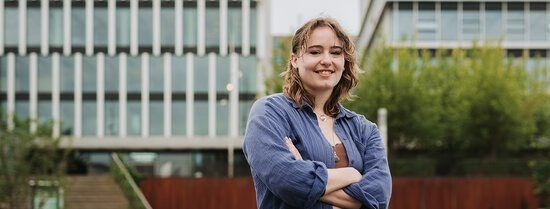


Portrait photo of alumna Simone Ruygrok

Compare @count study programme

  • @title

    • Duration: @duration
Compare study programmes