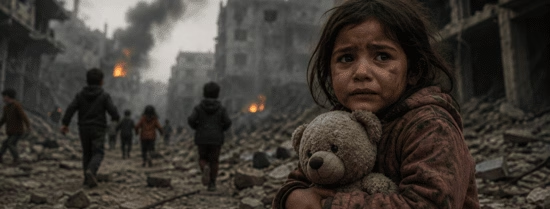
Children's rights are facing growing pressure worldwide, according to the KidsRights Index 2026, released on June 24 by the international children’s rights organisation KidsRights, in cooperation with Erasmus University Rotterdam. The annual ranking reveals a worrying global decline driven by escalating armed conflicts, a sharp increase in conflict-related sexual violence against children, and a worldwide childhood obesity epidemic.
The report shows that progress in advancing children's rights is slowing or reversing across much of the world. Only five countries improved their position in this year's Index, while 31 countries declined. At the same time, the number of countries in the highest-performing category fell by 30 percent compared with 2025, underscoring the scale of the global deterioration. ‘Children are increasingly exposed to risks they did not create and cannot control,’ says Marc Dullaert, Founder and Chairman of KidsRights. ‘Whether children are growing up in the shadow of war or in environments that undermine their health, the result is the same: their rights, wellbeing and future opportunities are being put at risk. The world is failing to provide children with the protection they are entitled to.’
Children increasingly under attack in armed conflicts
One of the most alarming findings of this year's research is the worsening impact of armed conflict on children. Across conflict zones worldwide, conflict-related sexual violence against children has increased by 35 percent since 2024. The report also highlights a growing trend of children being deliberately targeted and exploited as part of warfare, including through recruitment and other grave violations. According to KidsRights, conflict is destroying not only children's lives today but also their prospects for the future. The destruction of schools, the collapse of healthcare systems and the displacement of families deprive children of safety, stability and opportunity. KidsRights is calling on governments, international institutions and all parties involved in conflict to strengthen child protection measures, uphold international legal obligations, ensure accountability for serious violations against children, safeguard access to education and healthcare, and address the growing threat of conflict-driven food insecurity.
Childhood obesity surpasses underweight worldwide
For the first time in history, obesity among children and adolescents aged 5 to 19 exceeds underweight at the global level. According to the KidsRights Index, childhood obesity has become a worldwide epidemic affecting every region. Once considered primarily a challenge for high-income countries, rising levels of overweight and obesity are now increasingly affecting low- and middle-income countries as well. The highest prevalence rates are found in Latin America and the Caribbean and in the Middle East and North Africa.
KidsRights warns that many countries are now facing a double burden of malnutrition: persistent undernutrition alongside rapidly increasing obesity. Reflecting the growing significance of this issue, the KidsRights Index now includes childhood overweight and obesity as official health indicators. The report argues that obesity is driven not only by individual choices but also by unhealthy environments characterized by aggressive food marketing, widespread availability of ultra-processed products, limited opportunities for physical activity and unequal access to affordable, nutritious food. ‘When one in ten children is living with obesity, this is no longer simply about personal choices,’ Dullaert says. ‘It reflects environments that are failing children. Governments have a responsibility to protect children's health by addressing the systems that drive unhealthy outcomes.’
Netherlands falls to 22nd place
The Netherlands has once again dropped in the international KidsRights Index, falling to 22nd place. In just four years, the country has moved from a position in the global top ten to outside the top twenty, marking the second consecutive year it has ranked below twentieth place. The decline is primarily linked to a persistent increase in childhood obesity and rising child mortality. The report also points to a lack of progress on child poverty, online child sexual abuse material, the quality of youth care, and the prioritization of children's rights in asylum and migration policies.
The United Nations Committee on the Rights of the Child has previously expressed concern about childhood obesity and rising child mortality in the Netherlands. However, the latest data indicate that these negative trends have not yet been reversed. ‘Many people would not expect the Netherlands to decline specifically on these points,’ says Dullaert. ‘The figures show that the situation is deteriorating regarding fundamental health indicators for children. That should be a wake-up call.’
Currently, 13.4 percent of Dutch children and young people aged 4 to 20 are affected by overweight or obesity. Among children under the age of five, 5.4 percent are overweight. This places the Netherlands behind neighbouring countries such as Germany, where the figure stands at 3.3 percent, and Belgium at 4.9 percent. Obesity rates among Dutch children have been rising for more than two decades and are expected to continue increasing in the years ahead.

About the KidsRights Index
The KidsRights Index is the first and only global ranking that annually measures how children's rights are respected worldwide and the extent to which countries are committed to improving them. Initiated by KidsRights Foundation in 2013 and developed in cooperation with Erasmus School of Economics and the International Institute of Social Studies, the Index evaluates 194 countries across five domains: Right to Life, Right to Health, Right to Education, Right to Protection and Enabling Environment for Child Rights.
- More information
Click here for the full 2026 KidsRights Index and methodology. For more information, please contact Ronald de Groot, Media & Public Relations Officer at Erasmus School of Economics: rdegroot@ese.eur.nl, +31 653 641 846.
* The image with this article was generated by AI
