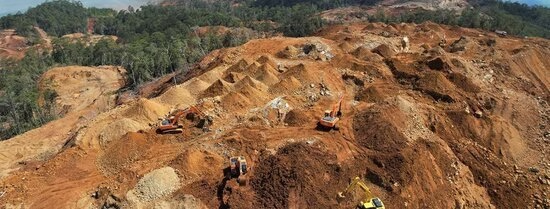
A new study by Maarten Bosker, Professor of International Trade and Development at Erasmus School of Economics, together with Else-Marie van den Herik (VU Amsterdam), Paul Pelzl (Norwegian School of Economics) en Steven Poelhekke (VU Amsterdam), sheds fresh light on the uneven impacts of export bans imposed by resource-rich countries with the aim of developing their own domestic processing industries.
Drawing on detailed evidence from Indonesia’s 2014 export ban on unprocessed nickel and bauxite ores, the authors show that such policies can have very different success, and, in fact, can even generate lasting economic harm.
Nickel: a policy success driven by rapid industrialisation
The research finds that the Indonesian export ban triggered a wave of investment in domestic nickel processing capacity. New smelters were built at speed and scale, enabling the country to capture significantly more value from its nickel reserves. As a result, the total export value of nickel ore and processed nickel products grew dramatically over the decade following the ban.
This industrial expansion also translated into meaningful local employment gains. In districts rich in nickel, or home to the new nickel smelters or stainless steel plants, jobs increased, with most of the growth occurring in manufacturing and services. According to the findings, a typical nickel-producing district added thousands of new jobs, contributing to a broader pattern of regional structural transformation.
Bauxite: a stark contrast
In sharp contrast, the ban on bauxite ore exports did not result in the same surge in domestic processing capacity. International buyers simply quickly shifted to bauxite ore suppliers in other countries, leaving Indonesian producers unable to pivot toward domestic smelting. And, they were unwilling to invest in Indonesian bauxite processing plants. Without new processing operations, bauxite-rich districts experienced falling export revenues and a persistent decline in employment. The study estimates that each affected district lost around 1.5 percent of its jobs, with most losses concentrated in the mining sector and few signs of workers being absorbed into other industries.
The comparison between nickel and bauxite underscores the central message of the research: export restrictions only deliver their intended economic benefits when they are matched by realistic and timely investment in downstream industries.
Environmental and energy-related spillovers
The authors also highlight important environmental side-effects. The construction of new nickel smelters required significant energy, much of which was supplied by coal-fired power plants built near the facilities. This led to a surge in coal mining in other parts of Indonesia, and severe air pollution in nickel processing districts. The employment and production gains in nickel districts thus came with heightened environmental and health costs.
These findings illustrate a striking paradox: a policy intended to support industries linked to clean-energy technologies (such as battery, and EV production) ended up strongly expanding the local burning of vast quantities of coal.
Implications for policymakers
The study of Bosker and co-authors concludes that export restrictions are not a reliable shortcut to industrial upgrading. Their success depends on whether governments can successfully attract investment in downstream processing, provide the necessary infrastructure and energy supply, and make sure that international buyers cannot easily switch to alternative producers.
Failing to meet these conditions, the authors warn, can lead to lower exports, job losses. Moreover, even in the regions successfully attracting the industrial capacity to process the minerals banned from export, the environmentally damaging side-effects may even outweigh the benefits in terms of its realized employment gains. Bosker and his co-authors are currently involved in a detailed study to quantify the local environmental consequences of Indonesia’s rapidly expanded nickel processing industry.
About the study
The research appears as part of the Centre for Economic Policy Research (CEPR) discussion paper series and offers one of the most comprehensive district-level analyses of Indonesia’s export ban to date. Maarten Bosker and his co-authors highlight that, as more countries consider export restrictions to promote domestic value-added industries, understanding the nuanced consequences of such policies is extremely important.
- Professor
- More information
Click here for the authors’ column on CEPR’s policy portal VoxEU. For more information, please contact Ronald de Groot, Media & Public Relations Officer at Erasmus School of Economics: rdegroot@ese.eur.nl, +31 6 53 641 846.
