Online retailers face a major challenge: high return rates, leading to costly logistics and environmental impact. In the Netherlands alone, 23 million packages were returned in 2020, with women’s fashion returns reaching up to 40.6% of sales. To tackle this, our team proposed and optimised an innovative customer-to-customer (C2C) return system, where returned items go directly from the old buyer to new buyers at a discount. Advanced mathematical modelling and real-world data demonstrate that this concept can increase profits by up to 34% and reduce warehouse workload.
‘In this innovative concept the return is sent to a next customer, where the next customer receives a discount for accepting such a return’
The C2C return concept
Almost everybody has returned items ordered online when these did not meet their expectations. This often happens in the case of clothes, as these have to fit. The customer returns them back to the seller, often for free. In turn, the internet seller receives the items, checks them, and stores them, ready to be sold again. Transporting and handling these returns is an enormous challenge for e-commerce sellers, especially in the clothing sector. All these transports create congestion and emissions, next to the handling costs at the warehouse. The question is how to address this issue effectively.
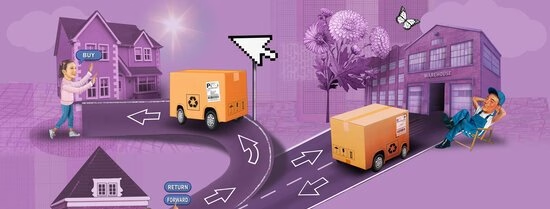
To answer this question, the C2C concept was proposed by Carl van Heijst from consultancy company Bearing Point. Together with Eline Tetteroo, a student in the Master's programme Econometrics and Management Science, we further developed and optimised the C2C concept. In this innovative concept the return is sent from the returning customer directly to a next customer, where the next customer receives a discount for accepting such a return.
In theory this is a nice idea, but to get it to work many operational details need to be specified. For instance, the return sender should be motivated to dispatch the return quickly. Additionally, do the discounted items cannibalise existing sales or would they lead to extra sales? This last issue would be crucial to an e-retailer to assess whether the concept is cost-effective.
Optimisation for profitable C2C returns
We guided Eline in translating the problem into a mathematical model and solving it with reinforcement learning (an AI optimisation tool), considering a continuous sale of a product. We tested the model on demand and return data from a large Dutch fashion retailer to determine the settings that yielded the best results. Additionally, we developed a second model that focused on an individual customer to gain deeper theoretical insights into the problem.
It appeared that the stylised customer-based model also gave good advice in case of multiple customers and that it outperformed the reinforcement learning method. The profitability depends on several factors though: how many customers participate in the concept, to which extent customers accept the returns, the cost of sending it to the next customer, and the time allowed to find another customer. In general, the results are promising. The so-called C2C concept yields an increase of 34% in expected profit in the most optimistic setting, while in pessimistic scenarios it is still 6% better. Finally, the amount of work at the e-commerce warehouse is reduced substantially, which is especially useful in busy periods.
From research to reality
A lot of dedication and persistence went into the research: developing and analysing the new model, redoing the calculations, and rewriting and polishing the paper. After some setbacks, we finally got our results published in a highly respected journal, a nice achievement for the researchers involved: Sena Eruguz, Oktay Karabag, Wilco van den Heuvel, and Rommert Dekker. Carl van Heijst even quit his job and created the start-up company It Goes Forward to commercialise the concept. Presently, the C2C concept is active at a webshop for sustainable clothing, and we hope many companies will follow.

About Wilco van den Heuvel
Wilco van den Heuvel is Professor of Operations Analytics at the Econometric Institute of Erasmus School of Economics, and currently academic director of the track Analytics and Operations Research in Logistics. His expertise is in Operations Research focused on the design of efficient algorithms, with applications in production planning and sustainable logistics.

About Rommert Dekker
Rommert Dekker is Professor Emeritus of Quantitative Logistics and Operations Research at Erasmus School of Economics. He has been working on port and maritime logistics, sustainability, service and reverse logistics.
- Professor
- Professor
- More information
This item is part of Backbone Magazine 2025. The magazine can be found in E-building or Theil-building for free. Additionally, a digital copy is available here. Backbone is the corporate magazine of Erasmus School of Economics. Since 2014, it is published once a year. The magazine highlights successful and interesting alumni, covers the latest economic trends and research, and reports on news, events, student and alumni accomplishments.
