Why this programme

Social Inequalities and Change
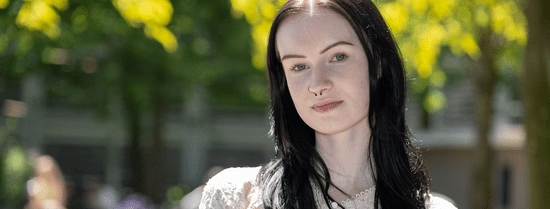
Aija Social Inequalities Master Student

What does this study entail?

How are social inequalities produced and maintained? Do family ties and education contribute to or improve inequalities? How can we make a positive contribution to our communities? This master's programme offers insights into the causes and consequences of social inequalities and sheds light on ways that individuals, groups, and governments can work toward social change.

We are witnesses to increasing social and political polarisation in our communities and countries while catchphrases such as detraditionalisation, globalisation, neoliberalism and automation involve real transformations of education, work and family life, of cities and states, and of people’s entitlements and international mobilities. Historic forces, such as colonization, are increasingly entering the public sphere of conversation as we connect the dots to pervasive inequalities today. Migration, whether voluntary or forced, has changed the face and structure of cities, schools and families whereas new technologies transform the very nature of our day-to-day lives. Within this context, it is vital to gain a better understanding of social inequalities to spur change.

Is this the right programme for you?

In this society studies programme, we want to understand the complex interplay between social structure, institutions, and individual behaviour. Therefore, it is important to bridge divisions between disciplines. This provides a detailed understanding of the ways in which social inequalities manifests across communities and contexts. 

Due to the unique interdisciplinary approach, you will learn to answer questions like:

  • How do social divisions such as race, ethnicity, class and gender frame our experiences of inequalities the world?
  • How does the interaction between markets (e.g. availability, quality, and cost of services) and states (e.g. social policies and national laws) shape family experiences and social inequalities?
  • How can policies and institutions produce, maintain, mitigate, or exacerbate social inequalities?
  • How can we radically imagine a better future?
still van Renske

Social Inequalities and Change

Graduation day of the master Social Inequalities and Change in 2020
Introduction day of the master Social Inequalities and Change in 2021

Testimonials

Jet Veenhoff

Jet Veenhoff - Alumna Social Inequalities and Change

I have learned so much about current events and issues in a clear and non-abstract manner, this programme gives you information you can really dig your hands into.
Jet Veenhoff testimonial
I have learned so much about current events and issues in a clear and non-abstract manner, this programme gives you information you can really dig your hands into.

After finishing my bachelor’s degree in Arts and Culture at Erasmus University Rotterdam, I took a full 2 years to decide what to do next. I knew I loved gender studies, sociology, and psychology and loved studying at Erasmus, however I also wanted to do something that was in tune with real issues connected to the world around me. I wanted to do something where I was dealing with relevant societal topics and I was unwilling to limit myself to only one aspect of society. After 2 years (and a pandemic) I finally found a programme that suited my needs and aspirations, the Social Inequalities and Change programme.

In the Social Inequalities and Change programme I feel I have flourished in ways I had not foreseen, and I look back at it with positive feelings only. Something that is of great value, and is also quite unique, is the programme's small scale. It is quite unique within academics and adds so much value to the experience of being a student in the programme. There is close contact with the heads of the programme, the teachers, and the tutors. Everyone is incredibly kind, helpful, and understanding of personal situations, which makes navigating the programme and dealing with the pressures of university a lot easier. Next to that I have thoroughly enjoyed the fact that everything I have learned has been rooted in, and connected to, the world around me. I have learned so much about current events and issues in a clear and non-abstract manner, this programme gives you information you can really dig your hands into. Moreover, within the assignments there is often room to pick topics that you as a student find most interesting, you have a personal connection to, or you wish to learn more about. This makes studying a lot more fun, as you’re allowed to follow your passions.

The last thing about the programme that really stuck with me, is its human approach to tough topics. Although, from an academic perspective, I have found that the topics discussed in the programme have been incredibly interesting, at times it can be hard to constantly think about social inequalities and the ways in which people are essentially suffering. Especially during the introductory course there was space to discuss how we, as students, felt during the start of the programme. Is it hard to think about these issues sometimes? Do you sometimes feel overwhelmed? Are some problems hitting close to home? It was completely okay to share this with fellow students and teachers, and everyone was more than supportive. I’ve really enjoyed having this communal feeling throughout the programme. On top of that there was such a willingness to receive and incorporate feedback. There was a lot of room for discussion about what ways of teaching work best for the group, and what might be causing issues. To me this was really refreshing and created a really nice and open atmosphere in which it is easy to feel safe and at home.

All in all, this programme has been an incredible experience that I wouldn’t trade for the world. For all of you interested in understanding, dissecting, and resolving social issues in today’s society, bring your passion along to this programme!

Jet Veenhoff testimonial

Renske Keizer

Prof. dr. Renske Keizer - Coordinator of the programme

In the last couple of decades, throughout the world, social inequalities have grown. We need to understand the social processes that sustain inequality and to develop social policies that can reduce it.
Prof. dr. Renske Keizer
In the last couple of decades, throughout the world, social inequalities have grown. We need to understand the social processes that sustain inequality and to develop social policies that can reduce it.
Prof. dr. Renske Keizer

Choosing a study is quite a challenge! Still in doubt about this study and want to have a good overview? Receive a clear digital brochure for this study.

Request brochure
Not sure yet about your choice? Request a brochure!

Compare @count study programme

  • @title

    • Duration: @duration
Compare study programmes