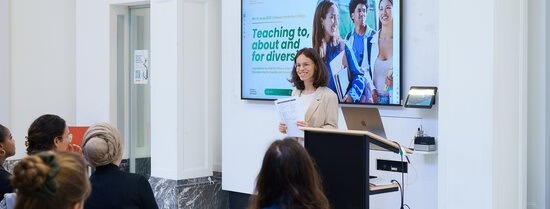
The feeling of belonging and of being valued is what every student needs in order to participate fully and learn well in class. But how can lecturers foster that? And what can students do to contribute to inclusive education? These and other questions were at the heart of the conference Learning About, To and for Diversity, organised by the ESSB D&I team.
The stately building of Erasmus University College, which welcomes students from all over the world, was a fitting venue. Around fifteen students, fifteen lecturers from various disciplines and several members of the support staff explored together how to design education in such a way that all students feel seen, heard, at home, and can succeed.
Teaching about, to and for diversity
The conference focused on three ways in which diversity plays a role in education: teaching about, to and for diversity. These were explained as follows by Professor of Education Sciences Sabine Severiens:
- Teaching about diversity: diversity as a substantive topic in the curriculum. For example, courses on different forms of migration and diversity, and theories that show how groups in society are unequally affected in their access to education, study pathways and outcomes.
- Teaching to diversity: teaching in a diverse classroom. What does diversity among students and lecturers mean for skills and ways of knowing and learning? And how can teaching methods, learning activities and the curriculum be aligned with this?
- Teaching for diversity: education that prepares students for a diverse labour market and society. Teaching then becomes a form of change, aimed at normalising and valuing diversity and promoting social justice.
During the conference, the emphasis was on teaching to and for diversity, with keynotes and workshops in which theory was continually linked to concrete teaching practices.

Belonging: keynote by Zehra Çolak
Following a brief introduction by ESSB Diversity Officer Maria Schiller, Zehra Çolak (Utrecht University) opened the conference with a keynote on the question: “How do you give students a sense of belonging?” Drawing on her research into the experiences and challenges of students with a migration background in higher education, she showed that for students from marginalised groups, feeling at home in education is far from self-evident.
Whether students feel welcome is linked to broader societal factors such as race, ethnicity, gender, social class, disability and sexual orientation. The feeling of belonging is therefore unequally distributed. It is shaped, among other things, by which groups are visible and represented, which (unwritten) rules and expectations apply, and how education is organised: which examples, theories and authors are foregrounded, and how teaching is delivered. These aspects often resonate more strongly with the life world of the dominant group than with that of other students. As a result, some students feel much more “in their element” than others.
Çolak emphasised that “caring about your students” is a daily practice. Students need to notice that a lecturer sees them, cares about them and is there for them. At the same time, she showed how complex it can be to recognise differences without isolating individuals. For instance, explicitly mentioning a student who identifies as they may be intended as recognition, but can unintentionally increase the distance from the rest of the group.
According to Çolak, making mistakes in this process is inevitable. What matters most is that lecturers are aware of their actions, are willing to engage in conversation and apologise when necessary. In her experience, students are willing to forgive mistakes when they see that a lecturer is sincerely doing their best to be there for them.

Teaching to diversity: “one size fits none”
Severiens stressed the importance of investing in students’ success and taking personal responsibility for it: truly seeing students and designing education that is accessible and inspiring for them. Equally important is actively fostering a sense of belonging.
Lecturers play a key role here. They can model respectful behaviour, be attentive to diverse needs and backgrounds, remain aware of their own biases and create a safe environment in which everyone can participate. This was also highlighted by Dr Jana Vietze, Dr Bahar Sakizlioglu-Uitermark and student Sarah Abbasi during the workshop on Teaching TO diversity.
By using a mix of strategies, lecturers can better respond to the diverse levels, interests and learning profiles in the classroom. It is important to start from students’ strengths.
Participants critically examined current teaching practices, such as participation grading, one-sided assessment formats and curricula with a limited diversity of perspectives. They argued for more flexible forms of assessment, a more inclusive curriculum and clear expectations for students. Inclusive education also requires institutional support, such as professional development, sufficient resources, smaller groups and the active involvement of students in the design of education.
One concrete example shared by Jana Vietze was a simple exercise in which students are invited to indicate what they would like their lecturer to know about them - a small step that makes it easier for teachers to see and respond to the individuals in front of them.

Inclusive transition to the labour market
In the workshop Inclusive transition to the labour market, led by Professor Marieke Meeuwisse with contributions from alumna Meryem Fitwi and Mervyn Nankoe (EUR Career Services), the central question was how universities can better support students – particularly first-generation students, international students and other underrepresented groups – in their transition from university to the labour market.
Participants discussed the importance of social capital: many students leave university without a professional network, mentors, or the skills needed to navigate the labour market. In addition, the transition is often laden with uncertainty, imposter syndrome and doubts about one’s own competencies, which for some groups are exacerbated by unequal opportunities and discrimination in internships and job applications.
A possible solution proposed was a Post Academic Programme, in which graduates receive support through alumni mentoring, networking training, workshops on workplace culture, recognising discrimination and gaining insight into sector specific career paths. The Tree of Strength model introduced in the workshop helps students reflect on their values, qualities, achievements and areas for development, enabling them to reflect on entering the labour market with greater confidence.

Shared responsibility for inclusive education
The Learning About, To and for Diversity conference made it clear that inclusive education is not the responsibility of a single lecturer or team, but a shared responsibility of lecturers, students and the university as a whole. Diversity was not framed as a problem to be solved, but as an enrichment that calls for conscious and inclusive practice.
By investing in lecturers’ professional development, critically reviewing curricula, actively involving students, and consistently focusing on connection, equality and care, we can create a learning environment in which every student feels welcome. A classroom where you belong – and where everyone has the opportunity to develop to their full potential.
- More information
ESSB Diversity Officer: dr. Maria Schiller, diversityinclusionteam@essb.eur.nl.
