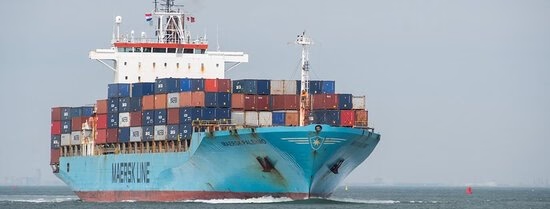
Maritime transport accounts for over 75% of global trade, and disruptions in vessel schedules often result in costly delays and operational inefficiencies at container terminals. This study investigates how arrival windows, speed adjustments and incentive mechanisms can improve vessel arrival planning with competitive, non-integrated shipping lines and terminals.
- Speaker
- Date
- Friday 4 Dec 2026, 12:00 - 13:00
- Type
- Seminar
- Room
- ET-14
- Building
- E Building
Yet literature has not addressed these aspects in an integrated way. We develop a stochastic optimisation framework in which we indicate how shipping lines should optimise individual vessel speeds given operational costs as well as arrival windows, earliness and lateness penalties as well compensation rates. These windows and penalties have been set at a tactical level by terminals. These windows, penalties, and compensation rates are determined by terminals at the tactical planning level.
The objective function incorporates a fairness component that discourages solutions in which delayed vessels incur lower overall costs than vessels arriving within their assigned time window. The framework enables the joint optimisation of tactical penalty parameters and operational vessel speeds. Five scenarios are evaluated, combining alternative speed-selection strategies, compensation policies, and different levels of communication among vessels and terminals.
The results show that without communication, penalties substantially improve both operational efficiency and fairness in sailing decisions. When precise forecasting and communication is applied, penalties have a limited effect, but the compensation policy still matters, especially if fairness grows in importance.
About the speaker
Pim van Leeuwen is a PhD candidate at Erasmus University, under supervision of Rommert Dekker. Born in Leiden (the Netherlands), he studied Econometrics and Economics in Rotterdam, followed by a Master in Operations Research and Quantitative Logistics.
He wrote his graduation thesis "Autonomous AGVs on a container terminal" at a consultancy called Portwise (formerly known as TBA). After graduating in 2019, he stayed with Portwise, working as a simulation consultant and then project manager.
Early 2026, Portwise was acquired by Haskoning, including all employees and continuing the company's longstanding reputation. In 2023, Pim started his parttime PhD, researching cooperation and communication between vessels and terminals. Together with Rommert Dekker, he has published two articles, while also working on multiple terminal design projects at Portwise/Haskoning.
Coordinators
See also


- More information
Lunch will be provided (vegetarian option included).
For more information please contact the Secretariat Econometrics at eb-secr@ese.eur.nl
