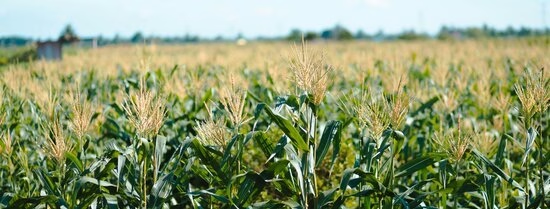
U.S. maize production supplies one-third of the global harvest and faces escalating risks from extreme weather. Despite decades of technological advances intended to enhance climate resilience, how large-scale yield sensitivity to temperature and rainfall has evolved remains poorly understood.
- Speaker
- Date
- Thursday 11 Jun 2026, 12:00 - 13:00
- Type
- Seminar
- Room
- ET-14
- Location
- Campus Woudestein
Joint work with Rick Geling, Raed Hamed and Corey Lesk
We track changing responses of county-level maize yields to temperature and precipitation across the U.S. Corn Belt from 1951 to 2024 using a time-varying coefficient panel regression model. Overall, we find that the combined effects of technological progress, management changes, irrigation expansion, and policy measures have delivered only partial and geographically uneven protection against rising heat, leaving constant or growing vulnerabilities in key producing regions.
These findings underscore the need for regionally targeted strategies to safeguard maize productivity as heat extremes intensify.
See also


- More information
Do you want to know more about the event? Contact the secretariat Econometrics at eb-secr@ese.eur.nl.
